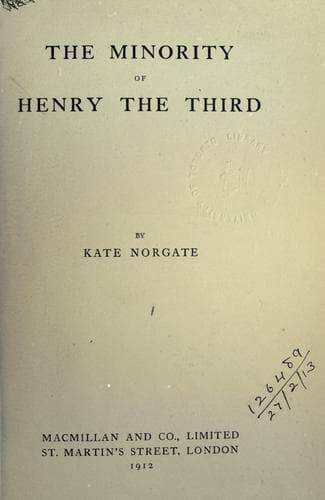
Great Britain -- History -- Henry III, 1216-1272; Henry III, King of England, 1207-1272
[934] Summons to Earls of Chester, Gloucester, and Aumale, John
constable of Chester, Robert de Vipont, Falkes, Brian de Lisle, and
Engelard de Cigogné, “quod veniatis ad nos apud Gloucestre hac die
dominica proxima post festum S. Andreae anno regni nostri octavo
[_i.e._, 3rd Dec., 1223] locuturi nobiscum die Lunae mane apud
Hospitale S. Johannis de Clerkenwelle vel apud Novum Templum Londoniae
vel alibi ubi de communi consilio melius providerimus.” _Pat. Rolls_,
vol. i. pp. 481, 482. “Gloucestre” is obviously a scribe’s error for
“Londoniam.”
[935] _Ann. Dunst._, p. 84. Cf. R. Coggeshall, p. 303, and _Quer.
Falc._, p. 261.
[936] _Ann. Dunst._, _l.c._
[937] _Quer. Falc._, pp. 261, 262.
[938] _Ib._
[939] _Pat. Rolls_, vol. i. p. 417.
[940] _Close Rolls_, vol. i. p. 578. Cf. Powicke, p. 222.
CHAPTER V
THE YOUNG KING
1223–1227
Aetatem habet; ipse de se loquatur.
[Sidenote: 1223]
The recognition of Henry’s partial coming of age (if such a phrase may
be allowed) in December, 1223, re-introduced into English politics and
into the government of England a factor which had been absent from them
for seven years, but which until John’s death had always been, and was
again to be for many generations, a factor of great, perhaps we should
rather say of the very greatest importance: the character and will of
the King. Thenceforth neither the Council as a body, nor any member
of it, could do any act in the King’s name without consulting him and
obtaining his sanction; nor could they, if the King desired anything
to be done which lay within the limits of his regal powers as defined
in October, 1223, prevent him from doing it, except by persuading him
to give up his desire in deference to their advice. The circumstances
by which such abnormal authority had become connected with the
justiciarship had ceased to exist; that office was once more reduced
within its proper limits; and if Hubert now aspired to rule England in
Henry’s name, the only way in which he could do so was by acquiring and
keeping complete personal ascendency over Henry himself. If, however,
the papal mandates which brought about this altered condition of things
had really been procured by Peter des Roches, in the hope that when
Hubert’s official importance was thus diminished he himself might
regain the foremost place in his old pupil’s confidence and become
the chief adviser of the Crown in Hubert’s stead, he was doomed to
wait a long time for the fulfilment of his hope. Until Henry’s final
coming of age and for many years after, so far as the King’s policy
was dictated by any one, it was dictated by Hubert de Burgh. But even
during the years which were still to elapse before Henry attained his
complete majority, Hubert’s dictatorship was very far from absolute.
In October, 1223, the King was sixteen years old; he was universally
esteemed an intelligent, serious-minded lad; and he had been carefully
educated. In later life he did not prove a man of lofty mental capacity
Public-domain text, read in full here on John Shaqi.
Reviews
Reviews
No reviews yet
Be the first to share your thoughts on this work.
Elsewhere in the archive
Join the Discussion
Join the discussion
Sign in to leave a comment or review.
Sign InorCreate an account