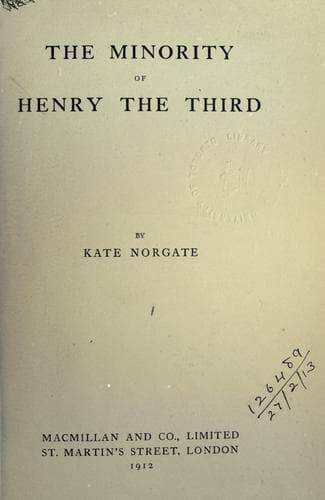
Great Britain -- History -- Henry III, 1216-1272; Henry III, King of England, 1207-1272
[1089] _Ann. Dunst._, p. 87. R. Wend., vol. iv. pp. 96, 97; cf. R.
Coggeshall, p. 206.
[1090] R. Wend., vol. iv. p. 97.
[1091] R. Coggeshall, _l.c._
[1092] “Forinseci.”
[1093] _Ann. Dunst._, pp. 87, 88.
[1094] _Roy. Lett._, vol. i. p. 233.
[1095] _Foedera_, I. i. p. 175.
[1096] “Tres aemuli mei quos ex causis evidentissimis suspectos
habebam”--“qui capitales inimici mei erant.” He does not give their
names. Two of them were unquestionably Hubert and Stephen; the third
may have been Earl William of Salisbury.
[1097] _Quer. Falc._, pp. 266, 267.
[1098] _Pat. Rolls_, vol. i. p. 461.
[1099] _Quer. Falc._, p. 267.
[1100] For the story of the surrender I have combined the accounts
given in _Ann. Dunst._, p. 88, R. Wend., vol. iv. p. 97, and R.
Coggeshall, p. 207. Cf. also W. Cov., vol. ii. p. 254, and _Quer.
Falc._, _ib._ p. 267.
[1101] _Ann. Dunst._, _l.c._
[1102] R. Wend., _l.c._
[1103] _Ann. Dunst._ and _Quer. Falc._, _ll.cc._
[1104] See Note XI.
[1105] _Quer. Falc._, p. 268.
[1106] Roger of Wendover, vol. iv. p. 98, says _fratres suos_, but
Matthew Paris, _Hist. Angl._, vol. ii. p. 265, who relates this scene
on the authority of an eyewitness, the Bishop of Coventry, speaks of
only one brother (William), and so does Falkes himself.
[1107] _Quer. Falc._, p. 268.
[1108] M. Paris, _l.c._
[1109] R. Wend. and M. Paris, _ll.cc._ The Barnwell annalist, W. Cov.,
vol. ii. p. 254, places this interview at Elstow.
[1110] R. Wend. and M. Paris, _ll.cc._
[1111] Stoke Courcy was part of the heritage of his wife. She and her
elder sister, Joan, wife of Hugh de Neville, were co-heiresses to the
lands of their father, Warin FitzGerold, who had been chamberlain to
Henry II, and who was now dead. See _Close Rolls_, vol. ii. pp. 10, 89
b.
[1112] _Ann. Dunst._, pp. 88, 89.
[1113] _Pat. Rolls_, vol. i. p. 462.
[1114] “Jurato autem stare mandatis Ecclesiae, in ruborem et
confusionem meam, Londoniis in die dedicationis ejusdem Sanctae
Trinitatis, affectata presentia plurimorum, idem archiepiscopus nudari
me faciens, sermonem ad populum facto ... tandem absolutum post verba
multa et probra me dimisit.” _Quer. Falc._, p. 268. We are not obliged
to accept Falkes’s description of Stephen’s discourse as containing
“blasphemias infinitas,” nor to believe that the words which he
proceeds to give as a quotation from it (_ib._) were actually spoken
by the Primate. His date--“die dedicationis ejusdem S. Trinitatis”--is
absolutely unintelligible to me; but the safe-conduct given him on 19th
August was to last till the 25th; and 25th August is also the date of
his final act of surrender, which would no doubt be made directly after
his absolution. That he was absolved before he made it is stated in the
deed itself.
Public-domain text, read in full here on John Shaqi.
Reviews
Reviews
No reviews yet
Be the first to share your thoughts on this work.
Elsewhere in the archive
Join the Discussion
Join the discussion
Sign in to leave a comment or review.
Sign InorCreate an account