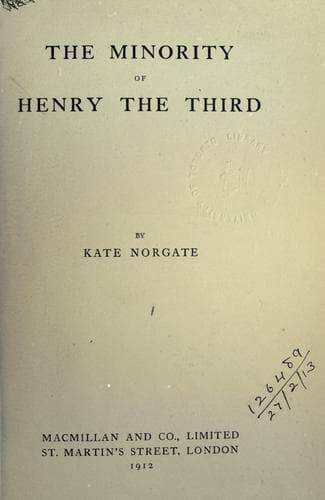
Great Britain -- History -- Henry III, 1216-1272; Henry III, King of England, 1207-1272
There can be no reasonable doubt that the series of dates so carefully
given in our fullest and most strictly contemporary account of the
transactions connected with the treaty between Henry and Louis--the
account in the _Histoire des Ducs de Normandie_--is correct. One of
the best contemporary English authorities, the Chronicle of Merton,
is in accord with it as to the dates on which the treaty was made and
Louis was absolved: “Hoc anno” (1217) “facta est pax ... in quadam
insula extra Kingestune, feria tercia ante Exaltationem S. Crucis”
(_i.e._, Tuesday, 12th September), “et in vigilia Exaltationis”
(Wednesday, 13th September) “absolutus est dominus Lodowicus in eadem
insula” (_Chron. Merton_, _apud_ Petit-Dutaillis, pp. 514–515).
Nearly all the other English chroniclers give a wrong date to the
peace; some make it 11th September, others 13th September. The Patent
Roll of 1216–17 settles the point against them all; “Si Reginaldus
de Cornhill terminos redempcionis suae, statutos ante _diem Martis
proximam ante Exaltacionem Sanctae Crucis_ anno regni nostro primo,
_qua pax reformata fuit_ inter nos et Lodovicum domini regis Franciae
primogenitum, servaverit,” etc. (_Pat. Rolls_, vol. i. p. 95, 25th
September, 1217).
The Barnwell annalist (W. Cov., vol. ii. p. 239) gives no date for
the peace, but says Louis was absolved “die Mercurii proxima post
Exaltationem S. Crucis,” _i.e._, 20th September. Curiously enough,
the copy of the treaty printed by D’Achéry (_Spicilegium_, ed. 1723,
vol. iii. pp. 586–7) appears to have borne the date “Lamech, anno ab
Incarnatione Domini MCCXVII, XX die Septembris.” Rymer, whose text
(_Foedera_, I. i. p. 148) corresponds almost _verbatim_ with D’Achéry’s
in all other respects, has the word _undecimo_ instead of the numerals
XX. The title of “treaty of Lambeth,” by which--in defiance of all our
authorities--the agreement is commonly known, is derived solely from
the dating clause as printed by Rymer and D’Achéry. No original copy
of the treaty appears to be now known. In the eighteenth century three
versions of it were printed, one by Rymer, one by D’Achéry, a third by
Martène and Durand (_Thesaurus Anecdotorum_, vol. i. pp. 857–859, ed.
1717). As to the source of Rymer’s copy we know absolutely nothing.
D’Achéry’s text was taken from the cartulary of the monastery of S.
Giles at Pontaudemer, that of Martène and Durand--which has no date
at all--“ex MS. illustrissimi Marchionis Daubais.” Both of these
must obviously have been mere copies; and they differ so widely from
each other that they cannot have been derived, even remotely, from
one and the same original. The Daubais text not only omits several
clauses entirely, as well as all mention of place, date, witnesses,
and seals, and gives other clauses in a shortened form, but it
inserts one interesting clause of which there is no trace anywhere
else--that about the Exchequer documents (above, footnote 315). The
Public-domain text, read in full here on John Shaqi.
Reviews
Reviews
No reviews yet
Be the first to share your thoughts on this work.
Elsewhere in the archive
Join the Discussion
Join the discussion
Sign in to leave a comment or review.
Sign InorCreate an account