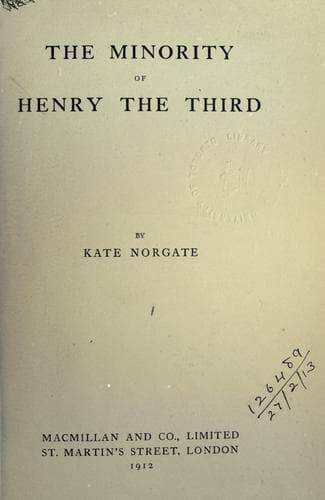
Great Britain -- History -- Henry III, 1216-1272; Henry III, King of England, 1207-1272
(2) The difficulty about the dates, both of time and place, practically
disappears if we adopt the second theory. The date in Rymer can hardly
be explained away as a transcriber’s error, because the word _undecimo_
is given in full; it must be either correct, or a downright blunder.
Now, we know from _Hist. Ducs_ (p. 203) that 11th September was the
day on which Malaunay carried back to Louis the “form of peace drawn
up in writing” (R. Wend., vol. iv. p. 30; cf. above, pp. 56, 57) for
his acceptance. The Pontaudemer text may have been transcribed from a
copy in which the word had been translated into numerals, and if so,
“XI” might easily become “XX” in transcription. As for the place, we
know that King and regent were at Chertsey every day from 6th September
to 12th September, both days inclusive, and we possess no other notice
of their having gone to Lambeth on the 11th; but there is no reason
why they should not have done so; a prolongation of the truce till
the 14th had been guaranteed on the 10th, and it would be quite safe
and practicable for the Marshal and the Legate to bring their royal
charge as near to London as Lambeth for a few hours, if they found it
convenient to do so as a means of saving time in communicating with
Louis.
Mr. G. J. Turner (“Minority of Henry III,” part I, _Trans. Roy. Hist.
Soc._, series II, vol. xviii. p. 288, note 3) says, “The treaty was in
two parts, of which the text in the _Thesaurus_ is the part executed
by Louis.” I do not understand on what grounds this inference is
based, as the Daubais (or _Thesaurus_) text has no attestations, and
the formulae employed in it are precisely the same as those in the
Rymer-Pontaudemer text, which purports to be attested by the English
party. Indeed, I cannot bring myself to believe that the Daubais text
can possibly represent the form in which the treaty was “executed” at
all. Save for the one clause which is peculiar to it, it is a mere
summary, and a very imperfect one, of some--by no means all--of the
conditions which the Rymer-Pontaudemer text sets forth in detail. My
inference from a comparison of the two texts is that the Daubais text
is a mere scribe’s epitome of a third text, now lost, which probably
was the true text of the treaty actually executed at Kingston on 12th
September, and consisted of the substance of the preliminary draft (the
Rymer-Pontaudemer text) _plus_ the article about the Exchequer records.
NOTE VI
THE TENURE OF CROWN OFFICES DURING THE MINORITY
Public-domain text, read in full here on John Shaqi.
Reviews
Reviews
No reviews yet
Be the first to share your thoughts on this work.
Elsewhere in the archive
Join the Discussion
Join the discussion
Sign in to leave a comment or review.
Sign InorCreate an account