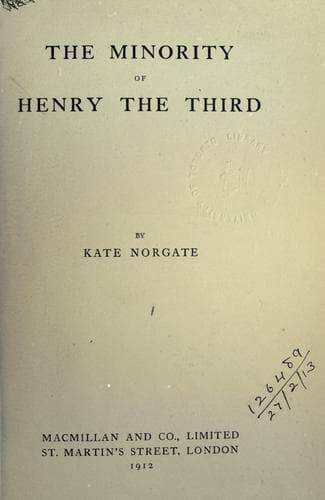
Great Britain -- History -- Henry III, 1216-1272; Henry III, King of England, 1207-1272
Ralf of Coggeshall’s story is not self-consistent. He begins by
stating, as a positive fact, that John had given Bedford castle to
Falkes by charter. Afterwards, however, this fact dwindles down to an
assertion reported to have been made by Falkes in answer to a demand
in 1223–1224 for restitution of the castle either to the King or to
Beauchamp. No charter such as is here mentioned appears in the Charter
Rolls of John’s reign. This of course does not prove that no such
charter ever existed; nor does the fact that the Patent and Close
Rolls of Henry’s reign contain no hint of Falkes’s having ever, before
the capture of Henry de Braybroke, been summoned to deliver up the
castle, prove that no such summons was ever issued. The words of Falkes
himself and those of the Pope--these latter being of course based on
information derived from Falkes or his friends--imply that he claimed
to hold the castle in fee. But even if this claim was really based on a
charter, it could scarcely have availed to bar the claim of the King;
for by the treaty of Kingston the Crown as well as its subjects, was
to regain whatever it had been seised of before the war, and it had
certainly been seised of Bedford castle from the time of Henry II till
the autumn of 1215; it seems therefore that Henry might have considered
himself entitled to treat a charter granted by his father after that
date as null and void, and thus to call Bedford _castrum nostrum_. With
regard to its custody as a royal castle, the law of the matter may very
likely have been quite uncertain. It may have been at least arguable
that the definition laid down in the treaty did not necessarily cover
the custody of a royal castle even if held by hereditary right; and
it must be remembered that we do not know what was the precise nature
of the tenure by which Beauchamp had held that office. The Barnwell
writer, however, certainly appears to have gone too far in stating
that the castle itself “de jure spectabat ad Willelmum de Bello Campo.”
It had belonged to William’s ancestors; but William’s father had
practically renounced all claim to its ownership by fining with King
Richard for the office of its constable. William’s right in it was at
the utmost only an hereditary title to that office. Whether John did
grant the castle to Falkes in fee, or whether he died seised of it
himself (as Hubert said)--having given merely the custody of it, as
well as the enjoyment of the honour of Bedford, to Falkes _quamdiu regi
placuerit_--we cannot determine. From Henry’s accession till autumn,
1223, any question which might exist on the subject between Falkes and
the Crown was of little practical consequence. It was recognized on
all hands that throughout that period whatever castles Falkes held,
whether as constable or as lord, he held loyally for the King and used
for the King’s interest with a rare capability and diligence. Henry’s
counsellors might well prefer to leave this particular detail of the
Public-domain text, read in full here on John Shaqi.
Reviews
Reviews
No reviews yet
Be the first to share your thoughts on this work.
Elsewhere in the archive
Join the Discussion
Join the discussion
Sign in to leave a comment or review.
Sign InorCreate an account