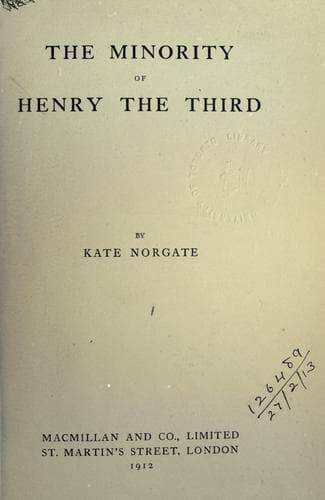
Great Britain -- History -- Henry III, 1216-1272; Henry III, King of England, 1207-1272
also included, above all else, what the men of the Middle Ages called
“loyalty.” Primarily, to them, loyalty meant the faithful discharge of
the obligations legally involved in the relation between vassal and
lord; obligations, indeed, often disregarded and violated in practice,
but theoretically acknowledged as sacred no less in the days of John
Lackland and Philip Augustus than in the days when they inspired one
of the noblest outbursts of feeling in the noblest epic of ancient
France.[348] This principle of “loyalty” in the medieval sense was
the rule by which the Marshal walked, with a rare steadfastness and
consistency, throughout his life. The very passages in his career which
seem at first glance most difficult to reconcile with modern ideas on
the subject are in reality illustrations of the simple and literal
way in which he followed his rule, and were thoroughly understood as
such by the sovereigns against whom they brought him temporarily into
opposition.[349] He never concerned himself with abstract politics; in
any given circumstances, his sole concern was to do his own duty to his
own lord, whoever that lord might be. He knew neither doubt nor fear.
He was, indeed, constitutionally fearless; personal danger of any kind
was a thing of which he seems to have remained through life almost
as unconscious as when in early childhood, a hostage in the power of
Stephen and condemned to be hurled like a stone from a mangonel into
the castle which his father was defending for the Empress Maud, he
had disarmed the King’s wrath by running up to the deadly engine and
begging for a “swing” in it. But his courage never degenerated into
rashness; he was never eager to fight (except in a tournament) merely
for fighting’s sake, nor willing to countenance violent measures unless
they were imperatively called for by necessity or honour. His temper
was cool and practical. He was no pioneer of reform or of revolution;
he accepted without question the ordinary standards of public opinion
in his day.[350] His ideal was strictly the ideal of his own time; an
ideal, therefore, which all his contemporaries could understand and
appreciate, and which they could see to be fulfilled in his person more
completely than in that of any other man then living, at any rate in
England. As he was true and just in the fulfilment of his duty as a
vassal, so he was true and just in all his dealing. When he was but a
landless knight, living by the ransoms of the prisoners and the sale
of the horses captured by him in tournaments, men already knew that
his word was his bond. His lord the “young King,” Henry II’s son,
habitually “spent so much in every place where he went, that when
the hour of departure came, he knew not how to get away” from his
creditors. “Counts, barons, vavassours” vainly offered to stand surety
for the payment of his debts; the shrewd tradesmen would accept no
such security; but when the Marshal pledged his word that the accounts
Public-domain text, read in full here on John Shaqi.
Reviews
Reviews
No reviews yet
Be the first to share your thoughts on this work.
Elsewhere in the archive
Join the Discussion
Join the discussion
Sign in to leave a comment or review.
Sign InorCreate an account