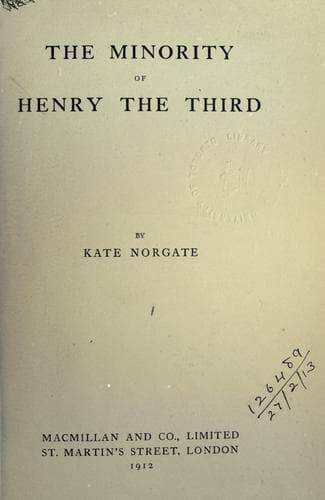
Great Britain -- History -- Henry III, 1216-1272; Henry III, King of England, 1207-1272
Some indications seem to point to another possible restriction on
the powers of the king’s guardians, in the shape of a theory that
their “pleasure” was not legally equivalent to “the King’s pleasure”;
in other words, that appointments made by the late King were not
revocable (except for some special reason) during the minority of his
successor. There is however no evidence that this theory was ever put
into explicit words or formally recognized;[365] and nothing of the
kind is needed to account for the fact that the great majority of the
Crown officers appointed by John were left undisturbed by the Earl
Marshal in their several bailiwicks.[366] Thirteen counties were at
John’s death under sheriffs of foreign birth. Falkes de Bréauté was
sheriff of Northamptonshire, Rutland, Cambridgeshire, Huntingdonshire,
Bedfordshire, Buckinghamshire, and Oxfordshire; Peter de Maulay of
Dorset and Somerset; Savaric de Mauléon of Hampshire; Philip Marc of
Derbyshire and Nottinghamshire; Engelard de Cigogné (or d’Athée) of
Surrey. The two last named were members of a family on which “the
Barons” of 1215 had conferred a signal mark of distinction, by making
it the subject of a separate article (the fiftieth) in the Great
Charter, whereby John was pledged “to remove altogether from their
bailiwicks the relations of Gerard of Athée,” several of whom, among
them Engelard of Cigogné and Philip Marc, are mentioned by name, “and
all their following, so that they may never more hold any bailiwick
in England.” The reason for this remarkable enactment was, so far as
can be made out from existing evidence, simply this: that when, after
a struggle in which Gerard of Athée fought gallantly for his country
and his Count,[367] the old Angevin lands were conquered by Philip
Augustus, these kinsmen--sprung from a group of little villages between
Tours and Loches--instead of settling down under the new ruler of
Touraine, crossed the sea to seek employment in the service of their
natural-born sovereign and make homes for themselves in his island
realm; that he entrusted them with offices of considerable importance
as well as (in some cases at least) of considerable pecuniary
value, and especially with the command of some of the chief royal
castles;[368] that they fulfilled the duties thus entrusted to them
with fidelity and efficiency, and that they had under their control a
numerous following of dependents who had accompanied or rejoined them
from beyond the sea, and who were, like them, faithful soldiers and
servants of the King. We need seek no further for the grounds on which
the “Barons of the Charter” desired to get rid of Gerard d’Athée and
his kindred;[369] nor for the grounds on which the fiftieth article
of the Great Charter was omitted in the revised version issued by
Gualo and the Marshal in Henry’s name. The only puzzle in the matter
is why the baronial party should have singled out the members of this
Public-domain text, read in full here on John Shaqi.
Reviews
Reviews
No reviews yet
Be the first to share your thoughts on this work.
Elsewhere in the archive
Join the Discussion
Join the discussion
Sign in to leave a comment or review.
Sign InorCreate an account