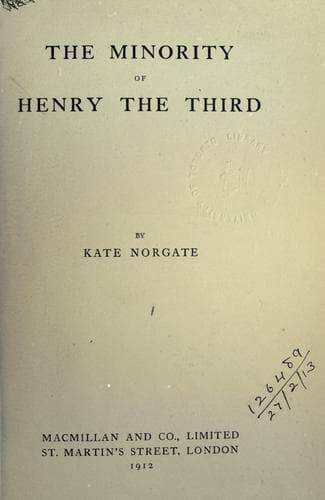
Great Britain -- History -- Henry III, 1216-1272; Henry III, King of England, 1207-1272
At Candlemas, 1219, the Marshal fell sick. The court was then in
London; but he seems to have been absent from it for a few days
when he was taken ill, for his biographer says he “rode to London
in pain.”[513] There, with his wife, he lodged in the Tower--still,
despite increasing illness, attending to the duties of his office--till
the middle of March, when, feeling that the end was drawing near, he
sent for his son and his men and “spoke comfortable words to them, as
he well knew how.” By the advice of “several who loved him heartily,”
he made his will, deliberately and carefully. Then he asked his son
and Henry FitzGerold to carry him to his manor of Caversham, “for
he thought he could bear his sickness more easily in his own house,
and if he were to die, it were better that he should be at home than
elsewhere.” They carried him thither in a boat, his wife accompanying
him in another boat.[514] The court seems to have immediately removed
from London to Reading, probably as the most convenient place where
the Council could all assemble within such a distance of Caversham as
enabled them to keep in constant communication with him.[515] To the
King and the Council at Reading he sent a message, asking that they
would all come to speak with him; and they came. “Simply they sat
around him” while he spoke to the King: “Fair sweet sir, in presence
of these barons I wish to tell you that when your father died and you
were crowned, it was arranged that you should be given into my charge,
and so you were, that I should defend your land, which is not easy to
hold. I have served you, I can truly say, loyally and to the uttermost
of my power; and I would serve you yet, if it pleased God to enable me;
but every one can see it is not His Will that I should abide longer in
this world. Wherefore it is fitting, so please you, that our baronage
choose some one who shall guard you and the realm in such a way, if he
can, as to please both God and men. And may God grant you to have such
a master as may be to our honour!” Up rose the Bishop of Winchester
and spoke: “Hearken now! Marshal, the land was given you to hold and
the realm to maintain, I grant it; but the King was given to me.” “Out
upon you!” said the Marshal, “Lord Bishop, that saying is wrong; you
should have held your peace. You were never concerned in this matter.
The time is not very long since you and the good Earl of Chester
besought me with tears that I would be guardian and master of the King
and the kingdom both together; your memory is short, meseems; and the
Legate was at great pains about the matter, and begged and commanded
me, till from you all, together with him, I received the King and the
kingdom. And when I had received the King, it was well seen and heard,
I assure you, that I gave the King into your hand, for he could not go
travelling about; therefore I gave him to you to take care of him.”
Here, seized with sudden pain, he turned to the Legate: “Go now, and
Public-domain text, read in full here on John Shaqi.
Reviews
Reviews
No reviews yet
Be the first to share your thoughts on this work.
Elsewhere in the archive
Join the Discussion
Join the discussion
Sign in to leave a comment or review.
Sign InorCreate an account