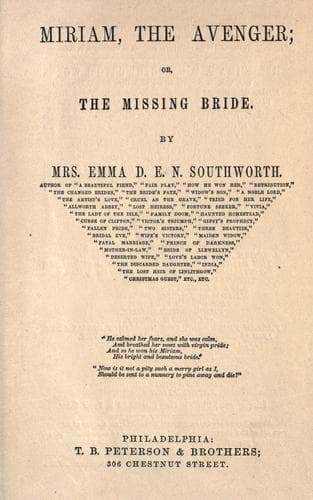
The Missing BrideSouthworth, Emma Dorothy Eliza Nevitte
General
The Missing Bride
Southworth, Emma Dorothy Eliza Nevitte
Fiction
Alice Morris was a hearty, cordial, blooming hoyden, really about ten or
eleven years of age, but seeming from her fine growth and proportions,
at least thirteen or fourteen.
Paul Douglass was a fine, handsome, well-grown boy of fourteen, with an
open, manly forehead, shaded with clustering, yellow curls, as soft and
silky as a girl's, and a full, beaming, merry blue eye, whose flashing
glances were the most mirth-provoking to all upon whom they chanced to
light. Paul was, and ever since his first arrival in the house had been,
"the life of the family." His merry laugh and shout were the pleasantest
sounds in all the precincts of Dell-Delight. When Paul first heard that
there was to be an invasion of "women and girls" into Dell-Delight, he
declared he had rather there had been an irruption of the Goths and
Vandals at once--for if there were any folks he could not get along
with, they were "the gals." Besides which, he was sure now to have the
coldest seat around the fire, the darkest place at the table, the
backward ride in the carriage, and to get the necks of chickens and the
tails of fishes for his share of the dinner. Boys were always put upon
by the girls, and sorry enough he was, he said, that any were coming to
the house. And he vowed a boyish vow--"by thunder and lightning"--that
he would torment the girls to the very best of his ability.
Girls, forsooth! girls coming to live there day and night, and eat, and
drink, and sleep, and sit, and sew, and walk up and down through the
halls, and parlors, and chambers of Dell-Delight--girls, with their
airs, and affectations, and pretensions, and exactions--girls--pah! the
idea was perfectly disgusting and offensive. He really did wonder at
"Brother," but then he already considered "Brother" something of an old
bachelor, and old bachelors would be queer.
But Thurston well knew how to smite the rock, and open the fountain of
sympathy in the lad's heart. He said nothing in reply to the boy's saucy
objections, but on the evening that little Miriam arrived, he beckoned
Paul into the parlor, where the child sat, alone, and pointing her out
to him, said in a low tone:
"Look at her; she has lost all her friends--she has just come from her
mother's grave--she is strange, and sad, and lonesome. Go, try to amuse
her."
"I'm going to her, though I hardly know how," replied the lad, moving
toward the spot where the abstracted child sat deeply musing.
"Miriam! Is that your name," he asked, by way of opening the
conversation.
"Yes," replied the child, very softly and shyly.
"It's a very heathenish--oh, Lord!--I mean it's a very pretty name is
Miriam, it's a Bible name, too. I don't know but what it's a saint's
name also."
The little girl made no reply, and the boy felt at a loss what to say
next. After fidgeting from one foot to the other he began again.
"Miriam, shall I show you my books--Scott's poems, and the Waverley
novels, and Milton's Paradise, and--"
Public-domain text, read in full here on John Shaqi.
Reviews
Reviews
No reviews yet
Be the first to share your thoughts on this work.
Elsewhere in the archive
Join the Discussion
Join the discussion
Sign in to leave a comment or review.
Sign InorCreate an account