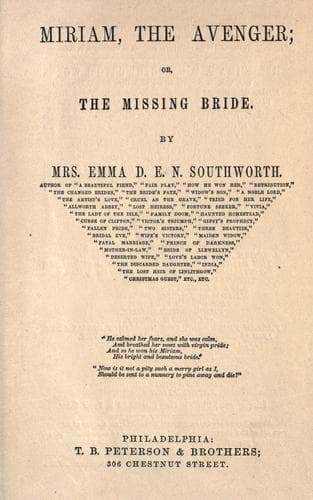
The Missing BrideSouthworth, Emma Dorothy Eliza Nevitte
General
The Missing Bride
Southworth, Emma Dorothy Eliza Nevitte
Fiction
At length the wounded self-esteem of the community received a healing
salve, in the form of a report that Mr. Willcoxen had withdrawn from the
gay world, in order the better to prepare himself for the Christian
ministry. A report that, in twelve months, received its confirmation in
the well established fact that Thurston Willcoxen was a candidate for
holy orders.
And in the meantime the young guardian did not neglect his youthful
charge, but in strict interpretation of his assumed duties of
guardianship, he had taken the education of the girl and boy under his
own personal charge.
"Many hard-working ministers of the Gospel have received pupils to
educate for hire. Why may not I, with more time at my command, reserve
the privilege of educating my own adopted son and daughter," he said,
and acting upon that thought, had fitted up a little school-room
adjoining his library, where, in the presence of Mrs. Morris, Miriam and
Paul pursued their studies, Mrs. Morris hearing such recitations as lay
within her province, and Mr. Willcoxen attending to the classical and
mathematical branches. Thus passed many months, and every month the
hearts of the children were knitted closer to each other and to their
guardian.
And Thurston Willcoxen "grew in favor, with God and man." His name
became the synonym for integrity, probity and philanthropy. He built a
church and a free-school, and supported both at his own expense. In the
third year after entering upon his inheritance, he was received into
holy orders; and two years after, he was elected pastor of his native
parish. Thus time went by, and brought at length the next eventful epoch
of our domestic history--that upon which Miriam completed her sixteenth
year.
CHAPTER XXX.
MIRIAM.
Six years had passed away. Thurston Willcoxen was the most beloved and
honored man, as well as the most distinguished clergyman of his day and
state. His church was always crowded, except when he changed with some
brother minister, whose pulpit was within reach--in which case, a great
portion of his congregation followed him. Many flattering "calls" had
the gifted and eloquent country parson received to metropolitan
parishes; but he remained the faithful shepherd of his own flock as long
as they would hear his voice.
Public-domain text, read in full here on John Shaqi.
Reviews
Reviews
No reviews yet
Be the first to share your thoughts on this work.
Elsewhere in the archive
Join the Discussion
Join the discussion
Sign in to leave a comment or review.
Sign InorCreate an account