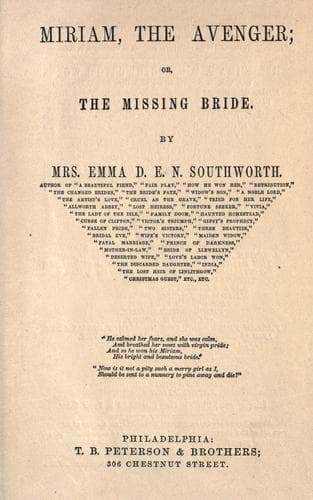
The Missing BrideSouthworth, Emma Dorothy Eliza Nevitte
General
The Missing Bride
Southworth, Emma Dorothy Eliza Nevitte
Fiction
As soon as our party made known their arrival to their friends, they
were inundated with calls and invitations. Brother clergymen called upon
Mr. Willcoxen, and pressed upon him the freedom of their houses. Alice
Morris and Mrs. Moulton, the relative with whom she was staying, called
upon Miriam, and insisted that she should go home with them, to remain
until after the wedding. But these offers of hospitality were gratefully
declined by the little set, who preferred to remain together at their
hotel.
The whole scene of metropolitan life, in its most stirring aspect, was
entirely new and highly interesting to our rustic beauty. Amusements of
every description were rife. The theatres, exhibition halls, saloons and
concert rooms held out their most attractive temptations, and night
after night were crowded with the gay votaries of fashion and of
pleasure. While the churches, and lyceums, and lecture-rooms had greater
charms for the more seriously inclined. The old and the young, the grave
and the gay, found no lack of occupation, amusement and instruction to
suit their several tastes or varying moods. The second week of their
visit, the marriage of Alice Morris and Oliver Murray came off, Miriam
serving as bridesmaid, Dr. Douglass as groomsman, and Mr. Willcoxen as
officiating minister.
But it is not with these marriage festivities that we have to do, but
with the scenes that immediately succeed them.
From the time of Mr. Willcoxen's arrival in the city, he had not ceased
to exercise his sacred calling. His fame had long before preceded him to
the capital, and since his coming he had been frequently solicited to
preach and to lecture.
Not from love of notoriety--not from any such ill-placed, vain glory,
but from the wish to relieve some overtasked brother of the heat and
burden of at least one day; and possibly by presenting truth in a newer
and stronger light to do some good, did Thurston Willcoxen, Sabbath
after Sabbath, and evening after evening, preach in the churches or
lecture before the lyceum. Crowds flocked to hear him, the press spoke
highly of his talents and his eloquence, the people warmly echoed the
opinion, and Mr. Willcoxen, against his inclination, became the clerical
celebrity of the day.
But from all this unsought world-worship he turned away a weary,
sickened, sorrowing man.
There was but one thing in all "the world outside" that strongly
interested him--it was a "still small voice," a low-toned, sweet music,
keeping near the dear mother earth and her humble children, yet echoed
and re-echoed from sphere to sphere--it was the name of a lady, young,
lovely, accomplished and wealthy, who devoted herself, her time, her
talents and her fortune, to the cause of suffering humanity.
Public-domain text, read in full here on John Shaqi.
Reviews
Reviews
No reviews yet
Be the first to share your thoughts on this work.
Elsewhere in the archive
Join the Discussion
Join the discussion
Sign in to leave a comment or review.
Sign InorCreate an account