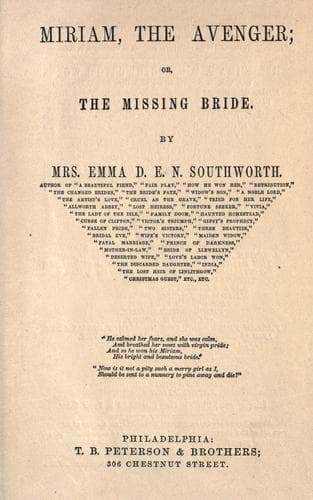
The Missing BrideSouthworth, Emma Dorothy Eliza Nevitte
General
The Missing Bride
Southworth, Emma Dorothy Eliza Nevitte
Fiction
Humane creatures are like climates--some of a temperate atmosphere,
taking even life-long sorrow serenely--never forgetting, and never
exaggerating its cause--never very wretched, if never quite happy.
Others of a more torrid nature have long, sunny seasons of bird-like
cheerfulness and happy forgetfulness, until some slight cause, striking
"the electric chain wherewith we are darkly bound," shall startle up
memory--and grief, intensely realized, shall rise to anguish, and a
storm shall pass through the soul, shaking it almost to dissolution, and
the poor subject thinks, if she can think, that her heart must go to
pieces this time! But the storm passes, and nature, instead of being
destroyed, is refreshed and ready for the sunshine and the song-birds
again. The elastic heart throws off its weight, the spirits revive, and
life goes on joyously in harmony with nature.
So it was with Jacquelina, with this sad difference, that as her trouble
was more than sorrow--for it was remorse--it was never quite thrown off.
It was not that her conscience reproached her for the fate of Dr.
Grimshaw, which was brought on by his own wrongdoing, but Marian's
fate--that a wild, wanton frolic of her own should have caused the early
death of one so young, and beautiful, and good as Marian! that was the
thought that nearly drove poor Jacquelina mad with remorse, whenever she
realized it. Dr. Grimshaw was forgiven, and--forgotten; but the thought
of Marian was the "undying worm," that preyed upon her heart. And so,
year after year, despite the arguments and persuasions of nearest
friends, and the constancy of poor Cloudy, Jacquelina tearfully turned
from love, friendship, wealth and ease, and renewed her vows of poverty,
celibacy, obedience, and the service of the poor, sick and ignorant, in
the hope of expiating her offense, soothing the voice of conscience, and
gaining peace. Jacquelina would have made her vows perpetual by taking
the black veil, but her Superior constantly dissuaded her from it. She
was young, and life, with its possibilities, was all before her; she
must wait many years before she took the step that could not be
retracted without perjury. And so each year she renewed her vow a
twelvemonth. The seventh year of her religious life was drawing to its
close, and she had notified her superior of her wish now, after so many
years of probation, to take the black veil, and make her vows perpetual.
And the Abbess had, at length, listened favorably to her expressed
wishes.
But a few days after this, as the good old Mother, Martha, the portress,
sat dozing over her rosary, behind the hall grating, the outer door was
thrown open, and a young man, in a midshipman's undress uniform, entered
rather brusquely, and came up to the grating. Touching his hat precisely
as if the old lady had been his superior officer, he said, hastily:
"Madam, if you please, I wish to see Mrs. ----; you know who I mean, I
presume? my cousin, Jacquelina."
Public-domain text, read in full here on John Shaqi.
Reviews
Reviews
No reviews yet
Be the first to share your thoughts on this work.
Elsewhere in the archive
Join the Discussion
Join the discussion
Sign in to leave a comment or review.
Sign InorCreate an account