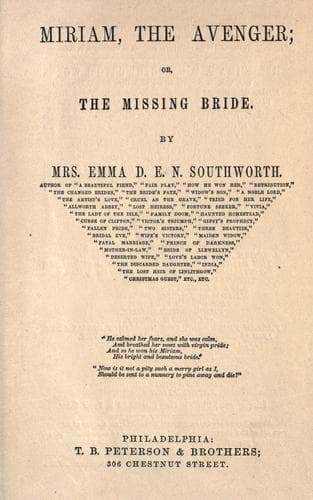
The Missing BrideSouthworth, Emma Dorothy Eliza Nevitte
General
The Missing Bride
Southworth, Emma Dorothy Eliza Nevitte
Fiction
In the meantime Marian's heart was weighed down by a new cause of sorrow
and anxiety. Thurston never approached her now, either in person or by
letter. She never saw him, except at the church, the lecture-room, or in
mixed companies, where he kept himself aloof from her and devoted
himself to the beautiful and accomplished heiress Angelica Le Roy, to
whom rumor gave him as an accepted suitor.
So free was Marian's pure heart from jealousy or suspicion that these
attentions bestowed by Thurston, and these rumors circulated in the
neighborhood, gave her no uneasiness. For though she had, for herself,
discovered him to be passionate and impetuous, she believed him to be
sound in principle. But when again and again she saw them together, at
church, at lecture, at dinner parties, at evening dances; when at all
the Christmas and New Year festivities she saw her escorted by him; when
she saw him ever at her side with a devotion as earnest and ardent as it
was perfectly respectful; when she saw him bend and whisper to the
witching girl and hang delighted on her "low replies," her own
confidence was shaken. What could he mean? Was it possible that instead
of being merely impulsive and erring, he was deliberately wicked? No,
no, never! Yet, what could be his intentions? Did he really wish to win
Angelica's heart? Alas! whether he wished so or not, it was but too
evident to all that he had gained her preference. In her blushing cheek
and downcast eyes, and tremulous voice and embarrassed manner, when he
was present, in her abstracted mind, and restless air of wandering
glances when he was absent, the truth was but too clear.
Marian was far too practical to speculate when she should act. It was
clearly her duty to speak to Thurston on the subject, and, repugnant as
the task was, she resolved to perform it. It was some time before she
had the opportunity.
But at last, one afternoon in February, she chanced to meet Thurston on
the sea beach. After greeting him, she candidly opened the subject. She
spoke gently and delicately, but firmly and plainly--more so, perhaps,
than another woman in the same position would have done, for Marian was
eminently frank and fearless, especially where conscience was concerned.
And Thurston met her arguments with a graceful nonchalance, as seemingly
polite and good-humored as it was really ironical and insulting.
Marian gave him time--she was patient as firm--and firm as sorrowful.
And until every argument and persuasion had failed, she said:
"As a last resort, it may be necessary for me to warn Miss Le Roy--not
for my own sake. Were I alone involved, you know how much I would endure
rather than grieve you. But this young lady must not suffer wrong."
"You will write her an anonymous letter, possibly?"
"No--I never take an indirect road to an object."
"What, then, can you do, fair saint?"
"See Miss Le Roy, personally."
"Ha! ha! ha! What apology could you possibly make for such an
unwarrantable interference?"
Public-domain text, read in full here on John Shaqi.
Reviews
Reviews
No reviews yet
Be the first to share your thoughts on this work.
Elsewhere in the archive
Join the Discussion
Join the discussion
Sign in to leave a comment or review.
Sign InorCreate an account