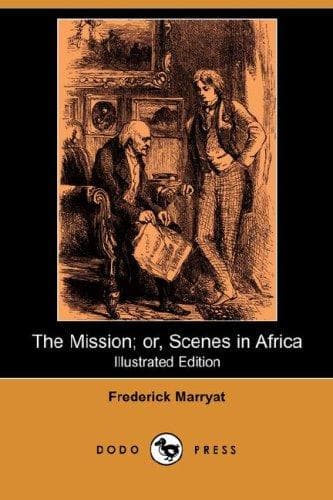
The Mission; or Scenes in AfricaMarryat, Frederick
General
The Mission; or Scenes in Africa
Marryat, Frederick
Adventure stories; Africa -- Fiction
Bremen reported that all the Hottentots had behaved very well, and that
Big Adam had nearly recovered, and was able to limp about a little,
although it would be a long while before he would regain the perfect use
of his leg. Alexander now sent for them all, and paid them their wages,
with an extra sum as a gratuity for their good conduct. To Bremen and
Swanevelt, who had invariably conducted themselves faithfully, and who
had been the leading and most trustworthy men, he gave to each a waggon
and span of ten oxen as a present, by which they might in future obtain
their livelihood; and the poor fellows considered themselves as rich as
the King of England. The other waggons and cattle of every description
were left with Swinton to be disposed of.
The Major pressed Swinton very hard to part with little Omrah, but
Swinton would not consent. The Major therefore presented Omrah with one
of his best rifles, and accoutrements to correspond, as a mark of his
attachment and Alexander desired that all the money which was realised
by the sale of the remaining waggons and other articles, as well as the
cattle and horses, should be put by for Omrah's benefit. As a keepsake,
Alexander gave the lad his telescope, with which he knew that Omrah
would be highly pleased.
We may here as well observe, that, a few months after Alexander and the
Major left the Cape, Omrah, who had been placed at a school by Swinton,
was admitted into the church, and baptised by the names of Alexander
Henderson Omrah; Alexander and the Major being his sponsors by proxies.
He turned out a very clever scholar, and remains with Swinton at this
moment. He has more than once accompanied him into the interior, and
has done much in reclaiming his countrymen, the Bushmen, from their
savage way of life, and has been of great service to the missionaries,
as interpreter of the Word to his heathen brethren.
About a fortnight after the return of the waggons to Cape Town, a
free-trader cast anchor in Table Bay to take in water, and Alexander and
the Major secured a passage in her to England. Alexander parted with
great regret from Mr Fairburn and Swinton, with whom he promised to
correspond; and they sailed with a fair wind for St. Helena, where they
remained for a few days, and took that opportunity of visiting the tomb
of Napoleon, the former Emperor of the French. A seven weeks' passage
brought them into the Channel, and they once more beheld the white
cliffs of England.
Alexander's impatience to see his uncle, from whom he had found a letter
waiting for him on his return to the Cape, stating that he was in
tolerable health, induced him to leave the ship in a pilot-boat, and
land at Falmouth. Taking leave for a time of the Major who preferred
going on to Portsmouth, Alexander travelled with all possible speed, and
on the second day arrived at his uncle's.
"Is my uncle quite well?" said Alexander, as he leaped out of the
chaise, to the old butler, who was at the door.
Public-domain text, read in full here on John Shaqi.
Reviews
Reviews
No reviews yet
Be the first to share your thoughts on this work.
Elsewhere in the archive
Join the Discussion
Join the discussion
Sign in to leave a comment or review.
Sign InorCreate an account