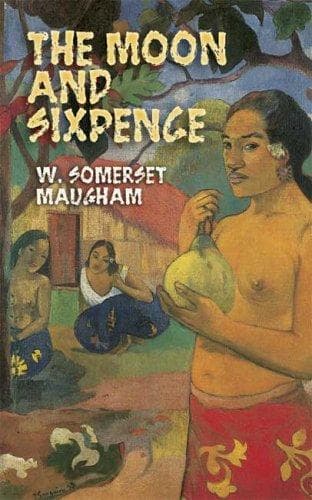
“Yes; she hadn’t a drop of white blood in her. Well, after I’d talked
to her I sent for Strickland, and I said to him: ‘Strickland, it’s time
for you to settle down. A man of your age shouldn’t go playing about
with the girls down at the front. They’re bad lots, and you’ll come to
no good with them. You’ve got no money, and you can never keep a job
for more than a month or two. No one will employ you now. You say you
can always live in the bush with one or other of the natives, and
they’re glad to have you because you’re a white man, but it’s not
decent for a white man. Now, listen to me, Strickland.’”
Tiaré mingled French with English in her conversation, for she used
both languages with equal facility. She spoke them with a singing
accent which was not unpleasing. You felt that a bird would speak in
these tones if it could speak English.
“‘Now, what do you say to marrying Ata? She’s a good girl and she’s
only seventeen. She’s never been promiscuous like some of these girls—a
captain or a first mate, yes, but she’s never been touched by a native.
_Elle se respecte, vois-tu._ The purser of the _Oahu_ told me last
journey that he hadn’t met a nicer girl in the islands. It’s time she
settled down too, and besides, the captains and the first mates like a
change now and then. I don’t keep my girls too long. She has a bit of
property down by Taravao, just before you come to the peninsula, and
with copra at the price it is now you could live quite comfortably.
There’s a house, and you’d have all the time you wanted for your
painting. What do you say to it?”
Tiaré paused to take breath.
“It was then he told me of his wife in England. ‘My poor Strickland,’ I
said to him, ‘they’ve all got a wife somewhere; that is generally why
they come to the islands. Ata is a sensible girl, and she doesn’t
expect any ceremony before the Mayor. She’s a Protestant, and you know
they don’t look upon these things like the Catholics.’
“Then he said: ‘But what does Ata say to it?’ ‘It appears that she has
a _béguin_ for you,’ I said. ‘She’s willing if you are. Shall I call
her?’ He chuckled in a funny, dry way he had, and I called her. She
knew what I was talking about, the hussy, and I saw her out of the
corner of my eyes listening with all her ears, while she pretended to
iron a blouse that she had been washing for me. She came. She was
laughing, but I could see that she was a little shy, and Strickland
looked at her without speaking.”
“Was she pretty?” I asked.
“Not bad. But you must have seen pictures of her. He painted her over
and over again, sometimes with a _pareo_ on and sometimes with nothing
at all. Yes, she was pretty enough. And she knew how to cook. I taught
her myself. I saw Strickland was thinking of it, so I said to him:
‘I’ve given her good wages and she’s saved them, and the captains and
the first mates she’s known have given her a little something now and
then. She’s saved several hundred francs.’
“He pulled his great red beard and smiled.
Public-domain text, read in full here on John Shaqi.
Reviews
Reviews
No reviews yet
Be the first to share your thoughts on this work.
Elsewhere in the archive
Join the Discussion
Join the discussion
Sign in to leave a comment or review.
Sign InorCreate an account