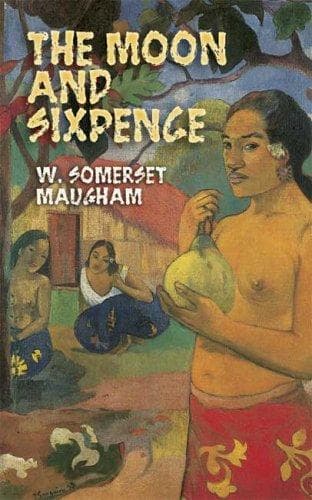
“I scarcely know. It was strange and fantastic. It was a vision of the
beginnings of the world, the Garden of Eden, with Adam and Eve—_que
sais-je?_—it was a hymn to the beauty of the human form, male and
female, and the praise of Nature, sublime, indifferent, lovely, and
cruel. It gave you an awful sense of the infinity of space and of the
endlessness of time. Because he painted the trees I see about me every
day, the cocoa-nuts, the banyans, the flamboyants, the alligator-pears,
I have seen them ever since differently, as though there were in them a
spirit and a mystery which I am ever on the point of seizing and which
forever escapes me. The colours were the colours familiar to me, and
yet they were different. They had a significance which was all their
own. And those nude men and women. They were of the earth, and yet
apart from it. They seemed to possess something of the clay of which
they were created, and at the same time something divine. You saw man
in the nakedness of his primeval instincts, and you were afraid, for
you saw yourself.”
Dr. Coutras shrugged his shoulders and smiled.
“You will laugh at me. I am a materialist, and I am a gross, fat
man—Falstaff, eh?—the lyrical mode does not become me. I make myself
ridiculous. But I have never seen painting which made so deep an
impression upon me. _Tenez_, I had just the same feeling as when I went
to the Sistine Chapel in Rome. There too I was awed by the greatness of
the man who had painted that ceiling. It was genius, and it was
stupendous and overwhelming. I felt small and insignificant. But you
are prepared for the greatness of Michael Angelo. Nothing had prepared
me for the immense surprise of these pictures in a native hut, far away
from civilisation, in a fold of the mountain above Taravao. And Michael
Angelo is sane and healthy. Those great works of his have the calm of
the sublime; but here, notwithstanding beauty, was something troubling.
I do not know what it was. It made me uneasy. It gave me the impression
you get when you are sitting next door to a room that you know is
empty, but in which, you know not why, you have a dreadful
consciousness that notwithstanding there is someone. You scold
yourself; you know it is only your nerves—and yet, and yet... In a
little while it is impossible to resist the terror that seizes you, and
you are helpless in the clutch of an unseen horror. Yes; I confess I
was not altogether sorry when I heard that those strange masterpieces
had been destroyed.”
“Destroyed?” I cried.
“_Mais oui_; did you not know?”
“How should I know? It is true I had never heard of this work; but I
thought perhaps it had fallen into the hands of a private owner. Even
now there is no certain list of Strickland’s paintings.”
Public-domain text, read in full here on John Shaqi.
Reviews
Reviews
No reviews yet
Be the first to share your thoughts on this work.
Elsewhere in the archive
Join the Discussion
Join the discussion
Sign in to leave a comment or review.
Sign InorCreate an account