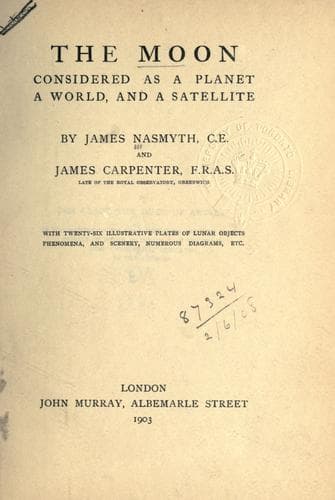
The Moon: considered as a planet, a world, and a satellite.Nasmyth, James
Science
The Moon: considered as a planet, a world, and a satellite.
Nasmyth, James
Moon
[Illustration: THE FORMATION OF THE CENTRAL CONE. FINAL ACTION OF A
LUNAR VOLCANO.]
[Illustration: PLATE XIII
ARZACHAEL, PTOLEMY, and the RAILWAY.]
CHAPTER IX.
ON THE GREAT RING-FORMATIONS NOT MANIFESTLY VOLCANIC.
In our previous chapter we have given a reason for regarding as true
volcanic craters all those circular formations, of whatever size, that
exhibit that distinctive feature _the central cone_. Between the
smallest crater with a cone that we can detect under the best telescopic
conditions, namely, the companion to Hell, 1¾ mile diameter, and the
great one called Petavius, 78 miles in diameter, we find no break in the
continuity of the crater-cum-cone system that would justify us in saying
that on the one side the volcanic or eruptive cause ceased, and on the
other side some other causative action began. But there are numerous
circular formations that surpass the magnitude of Petavius and its
peers, but that have no central cone, and are, therefore, not so
manifestly volcanic as those which possess this feature. Our map will
show many striking examples of this class at a glance. We may in
particular refer _inter alia_ to Ptolemy near the centre of the moon, to
Grimaldi (No. 125), Shickard (No. 28), Schiller (No. 24), and Clavius
(No. 13), all of which exceed 100 miles in diameter. Even the great
_Mare Crisium_, nearly 300 miles in diameter, appears to be a formation
not distinct from those which we have just named. These present little
of the generic crater character in their appearance; and they have been
distinguished therefrom by the name of _Walled_ or _Ramparted Plains_.
Their actual origin is beyond our explanation, and in attempting to
account for them we must perforce allow considerable freedom to
conjecture. They certainly, as Hooke suggested, present a “broken
bubble”-like aspect; but one cannot reasonably imagine the existence of
any form of mineral matter that would sustain itself in bubble form over
areas of many hundreds of square miles. And if it were reasonable to
suppose the great rings to be the foundations of such vast volcanic
domes, we must conclude these to have broken when they could no longer
sustain themselves, and in that case the surface beneath should be
strewed with _débris_, of which, however, we can find no trace.
Moreover, we might fairly expect that some of the smaller domes would
have remained standing: we need hardly say that nothing of the kind
exists.
[Illustration: Fig. 32.]
Public-domain text, read in full here on John Shaqi.
Reviews
Reviews
No reviews yet
Be the first to share your thoughts on this work.
Elsewhere in the archive
Join the Discussion
Join the discussion
Sign in to leave a comment or review.
Sign InorCreate an account