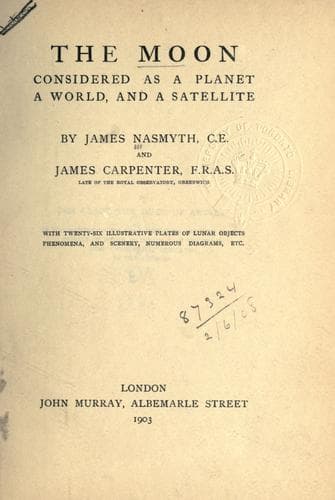
The Moon: considered as a planet, a world, and a satellite.Nasmyth, James
Science
The Moon: considered as a planet, a world, and a satellite.
Nasmyth, James
Moon
[6]The libratory movement has been taken advantage of, at the suggestion
of Sir Chas. Wheatstone, for producing stereoscopic photographs of
the moon. In the early days of stereoscopic photography the object
to be photographed was placed upon a kind of turn-table, and, after
a picture had been taken of it in one position, the table was turned
through a small angle for the taking of the second picture; the two
placed side by side then represented the object as it would have
been seen by two eyes widely separated, or whose visual rays
inclined at an angle equal to that through which the table was
turned; and when the pictures were viewed through a stereoscope,
they combined to produce the wonderful effect of solidity now
familiar to every one. The moon, by its librations, imitates the
turn-table movement; and, from a large number of photographs of her,
taken at different points of her orbit and at different seasons of
the year, it is possible to select two which, while they exhibit the
same phase of illumination, at the same time present the requisite
difference in the points of view from which they are taken to give
the effect of stereoscopicity when viewed binocularly. Mr. De la
Rue, the father of celestial photography, has been enabled to
produce several such pairs of pictures from the vast collection of
lunar photographs that he has accumulated. Any one of these pairs of
portraits, when stereoscopically combined, reproduces, to quote the
words of Sir John Herschel, “_the spherical_ form just as a giant
might see it whose stature were such that the interval between his
eyes should equal the distance between the place where the earth
stood when one view was taken, and that to which it would have to be
removed (our moon being fixed) to get the other. Nothing can surpass
the impression of _real corporeal form_ thus conveyed by some of
these pictures as taken by Mr. De la Rue with his powerful
reflector, the production of which (as a step in some sort taken by
man outside of the planet he inhabits) is one of the most remarkable
and unexpected triumphs of scientific art.”
[7]This is a point of some uncertainty. Dr. Young stated (Lectures Vol.
II. p. 575) that “a minute is perhaps nearly the smallest interval
at which two objects can be distinguished, although a line
subtending only a tenth of a minute in breadth may sometimes be
perceived as a single object.”
[8]Plate VIII.
[9]“Cosmos,” Bohn’s Edition, Vol. V. p. 322.
[10]_American Journal of Science, Second Series, Vol. II._
[11]“Volcanoes,” page 155.
Public-domain text, read in full here on John Shaqi.
Reviews
Reviews
No reviews yet
Be the first to share your thoughts on this work.
Elsewhere in the archive
Join the Discussion
Join the discussion
Sign in to leave a comment or review.
Sign InorCreate an account