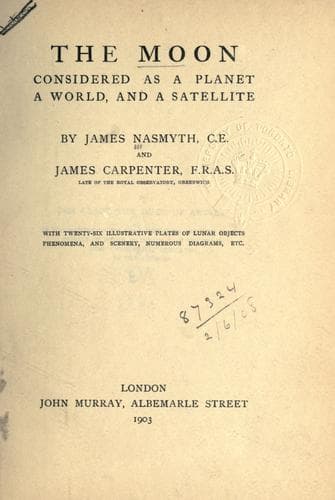
The Moon: considered as a planet, a world, and a satellite.Nasmyth, James
Science
The Moon: considered as a planet, a world, and a satellite.
Nasmyth, James
Moon
But perhaps the strongest evidence of the non-existence of any
appreciable lunar atmosphere is afforded by the non-refraction of the
light of a star passing behind the edge of the lunar disc. Refraction,
we know, is a bending of the rays of light coming from any object,
caused by their passage through strata of transparent matter of
different densities; we have a familiar example in the apparent bending
of a stick when half plunged into water. There is a simple schoolboy’s
experiment which illustrates refraction in a very cogent manner, but
which we should, from its very simplicity, hesitate to recall to the
reader’s mind did it not very aptly represent the actual case we wish to
exemplify. A coin is placed on the bottom of an empty basin, and the eye
is brought into such a position that the coin is just hidden behind the
basin’s rim. Water is then poured into the basin and, without the eye
being moved from its former place, as the depth of water increases, the
coin is brought by degrees fully into view; the water refracting or
turning out of their course the rays of light coming from the coin, and
lifting them, as it were, over the edge of the basin. Now a perfectly
similar phenomenon takes place at every sunrise and sunset on the earth.
When the sun is really below the horizon, it is nevertheless still
visible to us because it is _brought up_ by the refraction of its light
by the dense stratum of atmosphere through which the rays have to pass.
The sun is, therefore, exactly represented by the coin at the bottom of
the basin in the boy’s experiment, the atmosphere answers to the water,
and the horizon to the rim or edge of the basin. If there were no
atmosphere about the earth, the sun would not be so brought up above the
horizon, and, as a consequence, it would set earlier and rise later by
about a minute than it really does. This, of course, applies not merely
to the sun, but to all celestial bodies that rise and set. Every planet
and every star remains a shorter time below the horizon than it would if
there were no atmosphere surrounding the earth.
Public-domain text, read in full here on John Shaqi.
Reviews
Reviews
No reviews yet
Be the first to share your thoughts on this work.
Join the Discussion
Join the discussion
Sign in to leave a comment or review.
Sign InorCreate an account