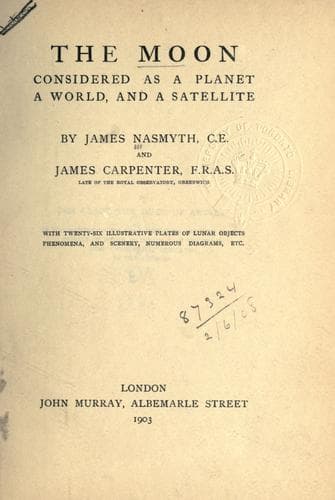
The Moon: considered as a planet, a world, and a satellite.Nasmyth, James
Science
The Moon: considered as a planet, a world, and a satellite.
Nasmyth, James
Moon
Sir John Herschel pointed out that if any moisture exists upon the moon,
it must be in a continual state of migration from the illuminated or
hot, to the unilluminated or cold side of the lunar globe. The
alternations of temperature, from the heat produced by the unmitigated
sunshine of 14 days’ duration, to the intensity of cold resulting from
the absence of any sunshine whatever for an equal period, must, he
argued, produce an action similar to that of the _cryophorus_ in
transporting the lunar moisture from one hemisphere to the other. The
cryophorus is a little instrument invented by the late Dr. Wollaston; it
consists of two bulbs of glass connected by a bent tube, in the manner
shown in the annexed illustration, fig. 13. One of the bulbs, A, is
half-filled with water, and, all air being exhausted, the instrument is
hermetically sealed, leaving nothing within but the water and the
aqueous vapour which rises therefrom in the absence of atmospheric
pressure. When the empty bulb, B, is placed in a freezing mixture, a
rapid condensation of this vapour takes place within it, and as a
consequence the water in the bulb A gives off more vapour. The
abstraction of heat from the water, which is a natural consequence of
this evaporation, causes it to freeze into a solid mass of ice. Now upon
the moon the same phenomenon would occur did the material exist there to
supply it. In the accompanying diagram let A represent the illuminated
or heated hemisphere of the moon, and B the dark or cold hemisphere; the
former being probably at a temperature of 300° above, and the latter
200° below Fahrenheit’s zero. Upon the above principle, if moisture
existed upon A it would become vapourised, and the vapour would migrate
over to B, and deposit itself there as hoarfrost; it would, therefore,
manifest itself to us while in the act of migrating by clouding or
dimming the details about the boundary of the illuminated hemisphere.
The sun, rising upon any point upon the margin of the dark hemisphere,
would have to shine through a bed of moisture, and we may justly
suppose, if this were the case, that the tops of mountains catching the
first beams of sunlight would be tinged with colour, or be lit up at
first with but a faint illumination, just as we see in the case of
terrestrial mountains whose summits catch the first, or receive the last
beams of the rising or setting sun. Nothing of this kind is, however,
perceptible: when the solar rays tip the lofty peaks of lunar mountains,
these shine at once with brilliant light, quite as vivid as any of those
parts that receive less horizontal illumination, or upon which the sun
is almost perpendicularly shining.
Public-domain text, read in full here on John Shaqi.
Reviews
Reviews
No reviews yet
Be the first to share your thoughts on this work.
Elsewhere in the archive
Join the Discussion
Join the discussion
Sign in to leave a comment or review.
Sign InorCreate an account