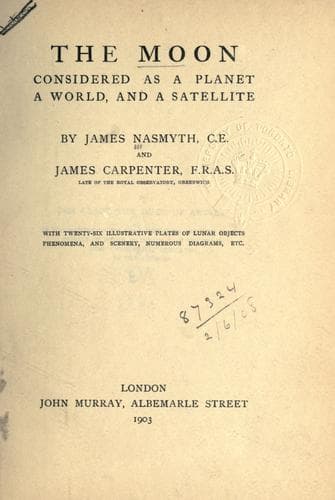
The Moon: considered as a planet, a world, and a satellite.Nasmyth, James
Science
The Moon: considered as a planet, a world, and a satellite.
Nasmyth, James
Moon
All the evidence, then, that we have the means of obtaining, goes to
prove that neither air nor water exist upon the moon. Two complicating
elements affecting all questions relating to the geology of the
terraqueous globe we inhabit may thus be dismissed from our minds while
considering the physical features of the lunar surface. Fire on the one
hand and water or the other, are the agents to which the configurations
of the earth’s surface are referrable: the first of these produced the
igneous rocks that form the veritable foundations of the earth, the
second has given rise to the superstructure of deposits that constitute
the secondary and tertiary formations: were these last removed from the
surface of our planet, so as to lay bare its original igneous crust,
that crust, so far as reasoning can picture it to us, would probably not
differ essentially from the visible surface of the moon. In considering
the causes that have given birth to the diversified features of that
surface, we may, therefore, ignore the influence of air and water action
and confine our reasoning to igneous phenomena alone: our task in this
matter, it is hardly necessary to remark, is materially simplified
thereby.
CHAPTER VI.
THE GENERAL ASPECT OF THE LUNAR SURFACE.
We have now reached that stage of our subject at which it behoves us to
repair to the telescope for the purpose of examining and familiarising
ourselves with the various classes of detail that the lunar surface
presents to our view.
Public-domain text, read in full here on John Shaqi.
Reviews
Reviews
No reviews yet
Be the first to share your thoughts on this work.
Elsewhere in the archive
Join the Discussion
Join the discussion
Sign in to leave a comment or review.
Sign InorCreate an account