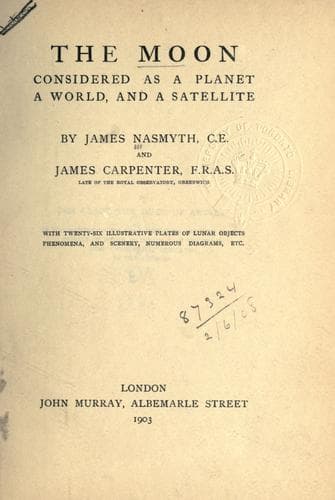
The Moon: considered as a planet, a world, and a satellite.Nasmyth, James
Science
The Moon: considered as a planet, a world, and a satellite.
Nasmyth, James
Moon
The most notable feature, however, in connection with this crater, and
on account of which we have chosen it as a subject for one of our
illustrations, is the very remarkable display of chasms or cracks which
may be seen to the west side of it. Several of these great cracks
obviously diverge from a small crater near the west external bank of the
great one, and they subdivide or branch out, as they extend from the
apparent point of divergence, while they are crossed or intersected by
others. These cracks or chasms (for their width merits the latter
appellation) are nearly one mile broad at the widest part, and after
extending to fully 100 miles, taper away till they become invisible.
Although they are not test objects of the highest order of difficulty,
yet to see them with perfect distinctness requires an instrument of some
perfection and all the conditions of good vision. When such are present,
a keen and practised eye will find many details to rivet its attention,
among which are certain portions of the edges of these cracks or chasms
which have fallen in and caused interruptions to their continuity.
THEOPHILUS, 97 (22·3—120·0). CYRILLUS, 96 (23·5—121·3). CATHARINA, 95
(24·7—124·0). Plate XII.
These three magnificent craters form a very conspicuous group near the
middle of the south-east quarter of the lunar disc.
Their respective diameters and depths are as follows:—
Theophilus, 64 miles diameter; depth of plateau from summit of crater
wall, 16,000 feet; central cone, 5200 feet high.
Cyrillus, 60 miles diameter; depth of plateau from summit of crater
wall, 15,000 feet; central cone, 5800 feet high.
Catharina, 65 miles diameter; depth of plateau from summit of crater
wall, 13,000 feet; centre of plateau occupied by a confused group of
minor craters and débris.
Each of these three grand craters is full of interesting details,
presenting in every variety the characteristic features which so
fascinate the attention of the careful observer of the moon’s wonderful
surface, and affording unmistakable evidence of the tremendous energy of
the volcanic forces which at some inconceivably remote period piled up
such gigantic formations.
Theophilus by its intrusion within the area of Cyrillus shows in a very
striking manner that it is of comparatively more recent formation than
the latter crater. There are many such examples in other parts of the
lunar disc, but few of so very distinct and marked a character.
Public-domain text, read in full here on John Shaqi.
Reviews
Reviews
No reviews yet
Be the first to share your thoughts on this work.
Elsewhere in the archive
Join the Discussion
Join the discussion
Sign in to leave a comment or review.
Sign InorCreate an account