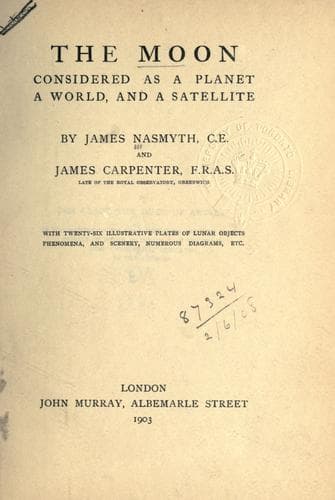
The Moon: considered as a planet, a world, and a satellite.Nasmyth, James
Science
The Moon: considered as a planet, a world, and a satellite.
Nasmyth, James
Moon
As we stated in our brief general description of the visible hemisphere
of the moon, and as a cursory glance at our map and plates will have
shown, the predominant features of the lunar surface are the circular or
amphitheatrical formations that, by their number, and from their almost
unnatural uniformity of design, induced the belief among early observers
that they must have been of artificial origin. In proceeding now to
examine the details of our subject with more minuteness than before,
these annular formations claim the first share of our attention.
By general acceptation the term “crater” has been used to represent
nearly all the circular hollows that we observe upon the moon; and
without doubt the word in its literal sense, as indicating a _cup_ or
circular cavity, is so far aptly applied. But among geologists it has
been employed in a more special sense to define the hollowing out that
is found at the summit of some extinct, and the majority of active,
volcanoes. In this special sense it may be used by the student of the
lunar surface, though in some, and indeed in the majority of cases, the
lunar crater differs materially in its form with respect to its
surroundings from those on the earth; for while, as we have said, the
terrestrial crater is generally a hollow on a mountain top with its flat
bottom high above the level of the surrounding country, those upon the
moon have their lowest points depressed more or less deeply below the
general surface of the moon, the external height being frequently only a
half or one-third of the internal depth. Yet are the lunar craters truly
volcanic; as Sir John Herschel has said, they offer the true volcanic
character _in its highest perfection_. We have upon the earth some few
instances in which the geological conditions which have determined the
surface-formation have been identical with those that have obtained upon
the moon; and as a result we have some terrestrial volcanic districts
that, could we view them under the same circumstances, would be
identical in character with what we see by telescopic aid upon our
satellite. The most remarkable case of this similarity is offered by a
certain tract of the volcanic area about Naples, known from classic
times as the _Campi Phlegræi_, or burning fields, a name given to them
in early days, either because they showed traces of ancient earth-fire,
or because there were attached to the localities traditions concerning
hot-springs and sulphurous exhalations, if not of actual fiery
eruptions. The resemblance of which we are speaking is here so close
that Professor Phillips, in his work on Vesuvius, which by the way
contains a historical description of the district in question, calls the
moon a grand Phlegreian field. How closely the ancient craters of this
famous spot resemble the generality of those upon the moon may be judged
from Plate VI., in which representations of two areas, terrestrial and
Public-domain text, read in full here on John Shaqi.
Reviews
Reviews
No reviews yet
Be the first to share your thoughts on this work.
Elsewhere in the archive
Join the Discussion
Join the discussion
Sign in to leave a comment or review.
Sign InorCreate an account