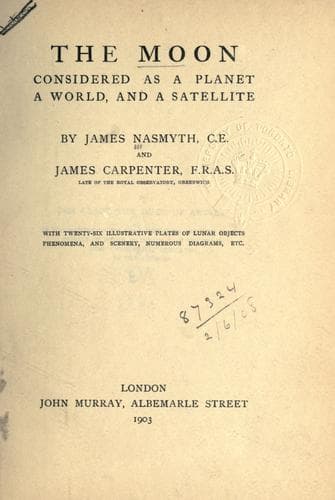
The Moon: considered as a planet, a world, and a satellite.Nasmyth, James
Science
The Moon: considered as a planet, a world, and a satellite.
Nasmyth, James
Moon
So long as each succeeding paroxysm was greater than its predecessor,
this excavating of the hollow and widening of its mouth and mound would
be extended. But when a weaker outburst came, or when the energy of the
last eruption died away, a process of slow piling up of matter close
around the vent would ensue. It is obvious that when the ejective force
could no longer exert itself to a great distance it must merely have
lifted its burden to the relieving vent and dropped it in the immediate
neighbourhood. Even if the force were considerable, the effect, so long
as it was insufficient to throw the ejecta beyond the rim of the crater,
would be to pile material in the lowermost part of the cavity; for what
was not cast over the edge would roll or flow down the inner slope and
accumulate at the bottom. And as the eruption died away, it would add
little by little to the heap, each expiring effort leaving the out-given
matter nearer the orifice, and thus building up the central cone that is
so conspicuous a feature in terrestrial volcanoes, and which is also a
marked one in a very large proportion of the craters of the moon. This
formation of the cone is pictorially described by Fig. 24.
[Illustration: Fig. 23.]
[Illustration: Fig. 24.]
In the volcanoes of the earth we observe another action either
concurrent with or immediately subsequent to the erection or formation
of the cone: this is the outflow or the welling forth of fluid lava,
which in cooling forms the well-known plateau. We have this feature
copiously represented upon the moon and it is presumable that it has in
general been produced in a manner analogous to its counterparts upon the
earth. We may conceive that the fluid matter was either spirted forth
with the solid or semisolid constituents of the cone, in which case it
would drain down and fill the bottom of the crater; or we may suppose
that it issued from the summit of the cone and ran down its sides, or
that, as we see upon the earth, it found its escape before reaching the
apex, by forcing its way through the basal parts. These actions are
indicated hypothetically for the moon in Fig. 25; and the parallel
phenomena for the earth are shewn by the actual case (represented in
Fig. 26 and on Plate I.) of Vesuvius as it was seen by one of the
authors in 1865, when the principal cone was vomiting forth ashes,
stones, and red-hot lava, while a vent at the side emitted very fluid
lava which was settling down and forming the plateau.
[Illustration: Fig. 25.]
Public-domain text, read in full here on John Shaqi.
Reviews
Reviews
No reviews yet
Be the first to share your thoughts on this work.
Elsewhere in the archive
Join the Discussion
Join the discussion
Sign in to leave a comment or review.
Sign InorCreate an account