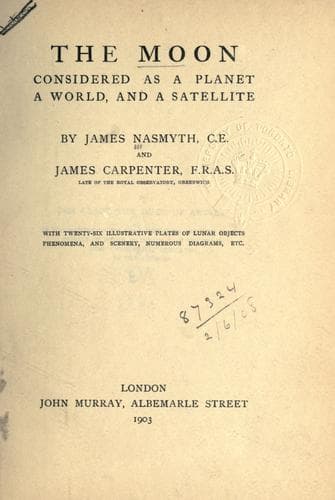
The Moon: considered as a planet, a world, and a satellite.Nasmyth, James
Science
The Moon: considered as a planet, a world, and a satellite.
Nasmyth, James
Moon
The question occurs whether other craters may not have been similarly
filled and have emptied themselves by the bursting of the wall under the
pressure of the accumulated lake of lava within. We know that this
breaching is a common phenomenon in the volcanoes of our globe; the
district of Auvergne furnishing us with many examples; and there are
some suspicious instances upon the moon. Copernicus exhibits signs of
such disruption, as also does the smaller crater intruding upon the
great circle of Gassendi. (See Frontispiece.) But the existence of such
discharging breaches implies the outpouring of a body of fluid or
semi-fluid material, comparable in cubical content to the capacity of
the crater, and of this we ought to see traces or evidence in the form
of a bulky or extensive lava stream issuing from the breach. But
although there are faint indications of once viscous material lying in
the direction that escaping fluid would take, we do not find anything of
the extent that we should expect from the mass of matter that would
constitute _a craterfull_. It is true that if the escaping fluid had
been very limpid it might have spread over a large area and have formed
a stratum too thin to be detected. Such a degree of limpidity as would
be required to fulfil this condition we are hardly, however, justified
in assuming.
To return to the subject of central cones. Although there are cases in
which the simple condition of a single cone exists, yet in the majority
we see that the cone-forming process has been divided or interrupted,
the consequence being the production of a group of conical hills instead
of a single one. Copernicus offers an example of this character, six,
some observers say seven, separate points of light, indicating as many
peaks tipped with sunshine, having been seen when the greater part of
the crater has been buried in shadow. Erastothenes, Bulialdus,
Maurolicus, Petavius, Langreen, and Gassendi, are a few among many
instances of craters possessing more than a central single cone. This
multiplication of peaks upon the moon doubtless arose from similar
causes to those which produce the same feature in terrestrial volcanoes.
Our sketch of Vesuvius in 1865 (Fig. 26) shows the double cone and the
probable source of the secondary one in the diverted channel of the
out-coming material. A very slight interruption in the first instance
would suffice to divert the stream and form another centre of action, or
a choking of the original vent would compel the issuing matter to find a
less resisting thoroughfare into open space, and the process of
cone-building would be continued from the new orifice, perhaps to be
again interrupted after a time and again driven in another direction. In
this manner, by repeated arrests and diversions of the ejecta, cone has
grown upon the side of cone, till, ere the force has entirely spent
itself, a cluster of peaks has been produced. It may have been that this
Public-domain text, read in full here on John Shaqi.
Reviews
Reviews
No reviews yet
Be the first to share your thoughts on this work.
Elsewhere in the archive
Join the Discussion
Join the discussion
Sign in to leave a comment or review.
Sign InorCreate an account