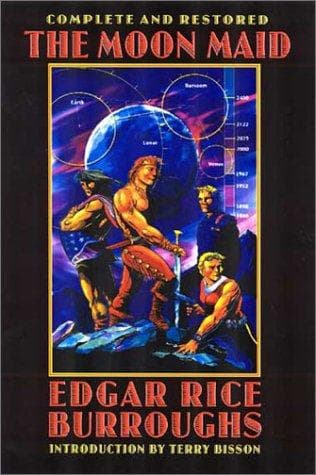
We are desert people. Our herds range a vast territory where feed is
scarce that we may be always near the goal that our ancestors set for us
three centuries ago—the shore of the western sea into which it is our
destiny to drive the remnants of our former oppressors. In the forests
and mountains of Arizona there is rich pasture, but it is far from the
land of the Kalkars where the last of the tribe of Or-tis make their
last stand, and so we prefer to live in the desert near our foes,
driving our herds great distances to pasture when the need arises,
rather than to settle down in a comparative land of plenty, resigning
the age-old struggle, the ancient feud between the house of Julian and
the house of Or-tis.
A light breeze moves the black mane of the bright bay stallion beneath
me. It moves my own black mane where it falls loose below the buckskin
thong that encircles my head and keeps it from my eyes. It moves the
dangling ends of the Great Chief’s blanket where it is strapped behind
my saddle. On the twelfth day of the eighth month of the year just gone
this Great Chief’s blanket covered the shoulders of my father, Julian
19th, from the burning rays of the summer’s desert sun. I was twenty on
that day and on that day my father fell before the lance of an Or-tis in
the Great Feud and I became The Chief of Chiefs.
Surrounding me today, as I sit looking down upon the land of my enemies,
are fifty of the fierce chieftains of the hundred clans that swear
allegiance to the house of Julian. They are bronzed and, for the most
part, beardless men. The insignias of their clans are painted in various
colors upon their foreheads, their cheeks, their breasts. Ochre, they
use and blue and white and scarlet. Feathers rise from the head bands
that confine their hair—the feathers of the vulture, the hawk and the
eagle. I, Julian 20th, wear a single feather. It is from a red-tailed
hawk—the clan-sign of my family.
We are all garbed similarly. Let me describe The Wolf, and in his
portrait you will see a composite of us all. He is a sinewy, well built
man of fifty, with piercing, gray-blue eyes beneath straight brows. His
head is well-shaped, denoting great intelligence. His features are
strong and powerful and of a certain fierce cast that might well strike
terror to a foeman’s heart—and does, if the Kalkar scalps that fringe
his ceremonial blanket stand for aught. His breeches, wide below the
hips and skin tight from above the knees down are of the skin of the
buck deer. His soft boots, tied tight about the calf of each leg, are
also of buck. Above the waist he wears a sleeveless vest of calfskin
tanned with the hair on. The Wolf’s is of fawn and white. Sometimes
these vests are ornamented with bits of colored stone or metal sewn to
the hide in various manners of design. From The Wolf’s headband, just
above the right ear, depends the tail of a timber-wolf—the clan-sign of
his family.
Public-domain text, read in full here on John Shaqi.
Reviews
Reviews
No reviews yet
Be the first to share your thoughts on this work.
Elsewhere in the archive
Join the Discussion
Join the discussion
Sign in to leave a comment or review.
Sign InorCreate an account