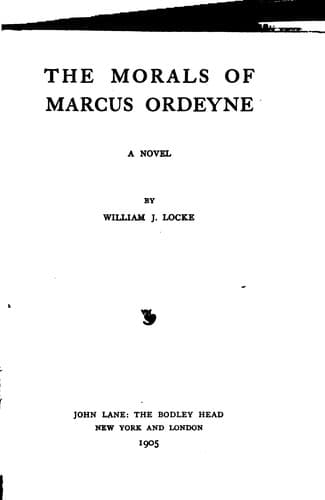
The Morals of Marcus Ordeyne : a NovelLocke, William John
Philosophy
The Morals of Marcus Ordeyne : a Novel
Locke, William John
Guardian and ward -- Fiction; Inheritance and succession -- Fiction; Scholars -- Fiction
When I looked at Judith, I was smitten with a great pain. She had not
looked so young, so fresh, so fragilely fair for many months. She wore
a dress of corn-flower blue that deepened the violet of her eyes. In the
mass of flax hued thistle-down that is her hair a blue argus butterfly
completed the chord of colour. There was the faintest tinge of pink
in her cheek applied with delicate art. Her dress seemed made of
unsubstantial dream stuff--I believe they call it chiffon--and it
covered her bosom and arms like the spray of a fairy sea. She had the
air of an impalpable Undine, a creation of sea-foam and sea-flower; an
exquisite suggestion of the ethereal which floated beauty, as it were,
into her face. I know little of women, save what these past few grievous
months have taught me; but I know that hours of anxious thought and
desperate hope lay behind this effect of fragile loveliness. The wit of
woman could not have rendered a woman’s body a greater contrast to that
of her rival; and with infinite subtlety she had imbued the contrast
with the deeper significance of rare and spiritual things. I know this
was so. I know it was a challenge, a defiance, an ordeal by combat; and
the knowledge hurt me, so that I felt like a Dathan or Abiram who
had laid hand on the Ark of the Covenant (for the soul of a woman, by
heaven! is a holy thing), and I wished that the earth could open and
swallow me up.
We sat down to table in the middle of the great room--a quiet corner
on the balcony away from the band is not to Carlotta’s taste--like any
conventional party of four, and at first talked of indifferent matters.
Conciergerie dinner-parties in the Terror always began with a discussion
of the latest cure for megrims, or the most fashionable cut of a panier.
Presently Pasquale who had been talking travel with Judith appealed to
me.
“What year was it, Ordeyne, that I came home from Abyssinia?”
“I forget,” said I. “I only remember you presenting me with that hideous
thing hanging in my passage, which you called a dulcimer.”
_“Gage d’amour?”_ smiled Judith.
Pasquale laughed and twirled his swaggering moustache.
“I did get it from a damsel, and that is why I called it a dulcimer, but
she didn’t sing of Mount Abora. I wish I could remember the year.”
“I think it was in 1894,” said Judith quietly.
Pasquale, who had been completely unaware of Judith’s existence until
half an hour before, could not repress a stare of polite surprise.
“I believe you are right. In fact, you are. But how can you tell?”
“Through the kindness of Sir Marcus,” replied Judith graciously, “you
are a very old acquaintance. I could write you off-hand a nice
little obituary notice with all the adventures--well, I will not say
complete--but with all the dates accurate, I assure you. I have a head
for that sort of thing.”
Public-domain text, read in full here on John Shaqi.
Reviews
Reviews
No reviews yet
Be the first to share your thoughts on this work.
Elsewhere in the archive
Join the Discussion
Join the discussion
Sign in to leave a comment or review.
Sign InorCreate an account