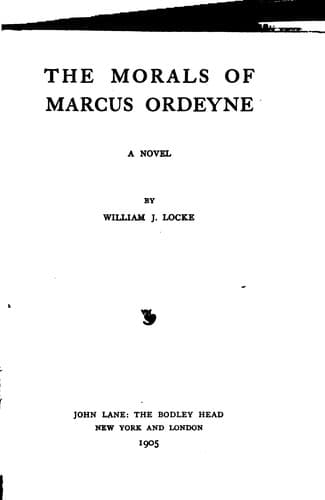
The Morals of Marcus Ordeyne : a NovelLocke, William John
Philosophy
The Morals of Marcus Ordeyne : a Novel
Locke, William John
Guardian and ward -- Fiction; Inheritance and succession -- Fiction; Scholars -- Fiction
“Who those fine ladies?” she cried, with her hands on my sleeve.
“Who _are_ those ladies?” I corrected.
“Who _are_ those ladies?” Carlotta repeated, like a demure parrot.
“They are friends of mine.”
Then came the eternal question.
“Is she married, the young one?”
“Miss Griggs,” said I, “kindly instil into Carlotta’s mind the fact that
no young English woman ever thinks about marriage until she is actually
engaged, and then her thoughts do not go beyond the wedding.”
“But is she?” persisted Carlotta.
“I wish to heaven she was,” I laughed, imprudently, “for then she would
not come and spoil my morning’s work.”
“Oh, she wants to marry you,” said Carlotta.
“Miss Griggs,” said I, “Carlotta will resume her studies,” and I went
upstairs, sighing for the beautiful tower with a lift outside.
July 14th.
Pasquale came in about nine o’clock, and found us playing cards.
He is a bird of passage with no fixed abode. Some weeks ago he gave up
his chambers in St. James’s, and went to live with an actor friend, a
grass-widower, who has a house in the St. John’s Wood Road close by. Why
Pasquale, who loves the palpitating centres of existence, should choose
to rusticate in this semi-arcadian district, I cannot imagine. He says
he can think better in St. John’s Wood.
Pasquale think! As well might a salmon declare it could sing better in a
pond! The consequence of his propinquity, however, has been that he
has dropped in several times lately on his way home, but generally at a
later hour.
“Oh, please don’t move and spoil the picture,” he cried. “Oh, you
idyllic pair! And what are you playing? Cribbage! If I had been
challenged to guess the game you would have selected for your
after-dinner entertainment, I should have sworn to cribbage!”
“An excellent game,” said I. Indeed, it is the only game that I
remember. I dislike cards. They bore me to death. So dus chess. People
love to call them intellectual pastimes; but, surely, if a man
wants exercise for his intellect, there are enough problems in this
complicated universe for him to worry his brains over, with more profit
to himself and the world. And as for the pastime--I consider that when
two or more intelligent people sit down to play cards they are insulting
one another’s powers of conversation. These remarks do not apply to my
game with Carlotta, who is a child, and has to be amused. She has picked
up cribbage with remarkable quickness, and although this is only the
third evening we have played, she was getting the better of me when
Pasquale appeared.
I repeated my statement. Cribbage certainly was an excellent game.
Pasquale laughed.
“Of course it is. A venerable pastime. Darby and Joan have played it of
evenings for the last thousand years. Please go on.”
But Carlotta threw her cards on the table and herself on the sofa and
said she would prefer to hear Pasquale talk.
“He says such funny things.”
Public-domain text, read in full here on John Shaqi.
Reviews
Reviews
No reviews yet
Be the first to share your thoughts on this work.
Elsewhere in the archive
Join the Discussion
Join the discussion
Sign in to leave a comment or review.
Sign InorCreate an account