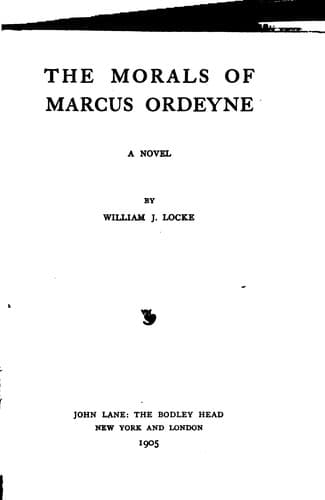
The Morals of Marcus Ordeyne : a NovelLocke, William John
Philosophy
The Morals of Marcus Ordeyne : a Novel
Locke, William John
Guardian and ward -- Fiction; Inheritance and succession -- Fiction; Scholars -- Fiction
I should love to stay all the summer with my old friend, It seems that
only from such a remote solitude can one view things mundane in the
right perspective, and in their true proportion. One would see how
important or unimportant portent in the cosmos was the agricultural
ant’s dream of three millimetres and an aphis compared with the
aspirations of the English labourer. One would justly focus the South
African millionaire, Sandy McGrath and the ram, and bring them to their
real lowest common denominator. One would even be able to gauge the
value of a History of Renaissance Morals. The benefits I should derive
from a long sojourn are incalculable, but my new responsibilities call
me back to London and its refracting and distorting atmosphere. If I had
dwelt here for fifty years I should have perceived that Carlotta was
but a speck in the whirlwind of human dust whose ultimate destiny was
immaterial. As my five days’ visit, however, has not advanced me to that
pitch of wisdom, I am foolishly concerned in my mind as to her welfare,
and anxious to dissolve the triumvirate, Miss Griggs, Stenson, and
Antoinette, whom I have entrusted with the reins of government.
A month ago, in similar circumstances, I should have railed at Fate and
anathematised Carlotta from the tip of her pink toes to the gold and
bronze glory of her hair. But I am growing more kindly disposed towards
Carlotta, and taking a keen interest in her spiritual development.
An inner voice, an ironical, sardonic inner voice with which there is no
arguing, tells me that I am a hypocrite; that an interest in Carlotta’s
spiritual development is a nice, comforting, high-sounding phrase which
has deluded philosophic guardians of female youth for many generations.
“What does it matter to you whether she has a soul or not,” says the
voice, “provided she can babble pleasantly at dinner and play cribbage
with you afterwards?”
Well, what on earth does it matter?
July 21st.
She was at Euston to meet me. As soon as she saw my face at the carriage
window she left Stenson and flew up the platform like a pretty tame
animal, and when I alighted hung on my arms and frisked and gamboled
around me in excess of joy.
“So you are glad to have me back, Carlotta?” I asked, as we were driving
home.
She sidled up against me in her terrier fashion.
“Oh, ye-es,” she cooed. “The day was night without you.”
“That is the oriental language of exaggeration,” I said. But all the
same it was pleasant to hear, and the soft notes of her voice coiled
themselves, as music sometimes dus, around my heart.
“I love dear Seer Marcous,” she said.
I put my arm round her waist for a moment, as one would do to a child.
“You are a good little girl, Carlotta. That is to say,” I added,
remembering my responsibilities, “if you _have_ been good. Have you?”
“Oh, so good. Antoinette has been teaching me how to cook, and I can
make a rice pudding. It is so nice to cook things. I like the smell. But
I burned myself. See.”
Public-domain text, read in full here on John Shaqi.
Reviews
Reviews
No reviews yet
Be the first to share your thoughts on this work.
Elsewhere in the archive
Join the Discussion
Join the discussion
Sign in to leave a comment or review.
Sign InorCreate an account