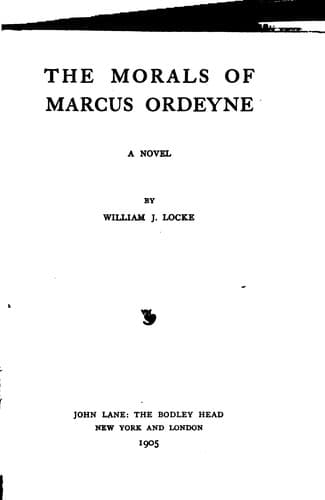
The Morals of Marcus Ordeyne : a NovelLocke, William John
Philosophy
The Morals of Marcus Ordeyne : a Novel
Locke, William John
Guardian and ward -- Fiction; Inheritance and succession -- Fiction; Scholars -- Fiction
But she makes a protesting grimace, and before I can stop her, runs back
to stake again on 5. In twenty minutes she is ruined and returns to me
wearing an expression of abject misery. She is too desolate even to try
the fortune of the dinner-jacket pocket. I take her outside and restore
her to beatitude with grenadine syrup and soda-water. She rejects the
straws. With her elbows on the marble table, the glass held in both
hands, she drinks sensuously, in little sips.
And I, Marcus Ordeyne, sit by watching her, a most contented philosopher
of forty. A dingo dog could not be so contented. That young fellow, I
unhesitatingly assert, must be the most brainless of his type. I suffer
fools gladly, as a general rule, but if I see much of this one I shall
do him some injury.
After dejeuner we strolled to the top of the west cliff and lay on the
thick dry grass. The earth has never known a more perfect afternoon. A
day of turquoise and diamond.
The air itself was diaphanous blue. Below us the tiny place slumbered in
the sunshine; scarcely a sign of life save specks of washer-women on the
beach bending over white patches which we knew were linen spread out to
dry. The ebb-tide lapped lazily on the shingle, where the sea changed
suddenly from ultramarine to a fringe of feathery white. A white sail
or two flecked the blue of the bay. A few white wisps of cirrus gleamed
above our heads. Around us, on the cliff-tops, the green pastures and
meadows and, farther inland, the cornfields stacked in harvest, and
great masses of trees. Lying on our backs, between sea and sky, we
seemed utterly alone. Carlotta and I were the sole inhabitants of the
earth. I dreamily disintegrated caramels from their sticky tissue-paper
wrappings for Carlotta’s consumption.
After a while unconquerable drowsiness crept over me; and a little
later I had an odd sense of perfect quietude. I was lying amid moss and
violets. In a languorous way I wondered how my surroundings had changed,
and at last I awoke to find my head propped on Carlotta’s lap and
shaded by her red parasol, while she sat happy in full sunshine. I was
springing from this posture of impropriety when she laughed and laid
restraining hands on my shoulders.
“No. You must not move. You look so pretty. And it is so nice. I put
your head there so that it should be soft. You have been sound asleep.”
“I have also been abominably impolite,” said I. “I humbly beg your
pardon, Carlotta.”
“Oh, I am not cross,” she laughed. Then still keeping her hands on me,
she settled her limbs into a more comfortable position.
“There! Now I can play at being a good little Turkish wife.” She
fashioned into a fan the _Matin_ newspaper, which I had bought for the
luxurious purpose of not reading, and fanned me. “That is what Ayesha
used to do to Hamdi. And Ayesha used to tell him stories. But my lord
does not like his slave’s stories.”
“Decidedly not,” said I.
Public-domain text, read in full here on John Shaqi.
Reviews
Reviews
No reviews yet
Be the first to share your thoughts on this work.
Elsewhere in the archive
Join the Discussion
Join the discussion
Sign in to leave a comment or review.
Sign InorCreate an account