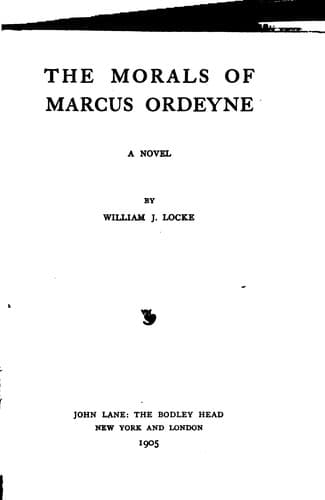
The Morals of Marcus Ordeyne : a NovelLocke, William John
Philosophy
The Morals of Marcus Ordeyne : a Novel
Locke, William John
Guardian and ward -- Fiction; Inheritance and succession -- Fiction; Scholars -- Fiction
But why should I be mad? For filling my soul with God’s utmost glory of
earth and sea and sky? For filling my heart with purest pleasure in
the intimate companionship of fresh and fragrant maidenhood? For giving
myself up for once to a dream of sense clouded by never a thought that
was not serenely fair?
For feeling young again?
I shall read myself to sleep with _La Dame de Monsoreau_, which I have
procured from the circulating library in the Rue Alphonse Karr--(the
literary horticulturist is the genius loci and the godfather of my
landlady)--and I will empty flagons with Pere Gorenflot and ride on
errands of life and death with Chicot, prince of jesters, and walk
lovingly between the valiant Bussy and Henri Quatre. By this, if by
nothing else, I recognise the beneficence of the high gods--they have
given us tired men Dumas.
CHAPTER XIII
September 30th.
Something is wrong with Antoinette. The dinner she served up this
evening was all but uneatable. Something is wrong with Stenson, who has
taken to playing his lugubrious hymn-tunes on the concertina while I
am in the house; I won’t have it. Something is wrong with the cat. He
wanders round the house like a lost soul, sniffing at everything. This
evening he actually jumped onto the dinner-table, looked at me out of
his one eye, in which all the desolation of two was concentrated, and
miaowed heart-rendingly in my face. Something is wrong with the house,
with my pens which will not write, with my books which have the air of
dry bones in a charnel-house, with the MS. of my History of Renaissance
Morals, which stands on the writing-table like a dusty monument to the
futility of human endeavour. Something is wrong with me.
Something, too, is wrong with Judith, who has just returned from her
stay with the Willoughbys. I have been to see her this evening and found
her of uncertain temper, and inclined to be contradictious. She accused
me of being dull. I answered that the autumn world outside was drenched
with miserable rain. How could man be sprightly under such conditions?
“In this room,” said Judith, “with its bright fire and drawn curtains
there is no miserable rain, and no autumn save in our hearts.”
“Why in our hearts?” I asked.
“How you peg one down to precision,” said Judith, testily. “I wish I
were a Roman Catholic.”
“Why?”
“I could go into a convent.”
“You had much better go to Delphine Carrere,” said I.
“I have only been back a day, and you want to get rid of me already?”
she cried, using her woman’s swift logic of unreason.
“I want you to be happy and contented, my dear Judith.”
“H’m,” she said.
Her slipper dangling as usual from the tip of her foot fell to the
ground. I declare I was only half conscious of the accident as my mind
was deep in other things.
“You don’t even pick up my slipper,” she said.
Public-domain text, read in full here on John Shaqi.
Reviews
Reviews
No reviews yet
Be the first to share your thoughts on this work.
Elsewhere in the archive
Join the Discussion
Join the discussion
Sign in to leave a comment or review.
Sign InorCreate an account