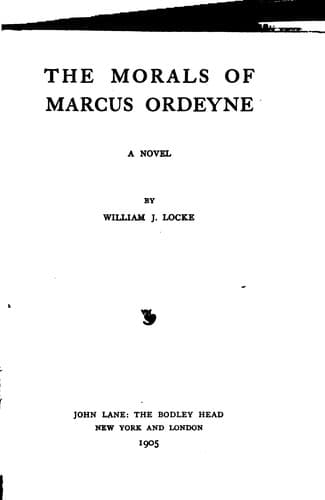
The Morals of Marcus Ordeyne : a NovelLocke, William John
Philosophy
The Morals of Marcus Ordeyne : a Novel
Locke, William John
Guardian and ward -- Fiction; Inheritance and succession -- Fiction; Scholars -- Fiction
I did not sleep last night. I have done no work to-day. The Renaissance
has receded into a Glacial Epoch wherein, as far as its humanity is
concerned, I have not a tittle of interest. I sought refuge in the
club. Why should an old sober University club be such a haven of unrest?
Ponting, an opinionated don of Corpus, seated himself at my luncheon
table, and discoursed on political economy and golf. I manifested a
polite ignorance of these high matters. He assured me that if I studied
the one and played at the other, I should be physically and mentally
more robust; whereupon he thumped his narrow chest, and put on a scowl
of intellectuality. I fear that Ponting, like most of the men here,
studies golf and plays at political economy. In serener moments I suffer
Ponting gladly. But to-day his boast that he had done the course at
Westward Ho! in seven, or seventeen, or seventy--how on earth should
I remember?--left me cold, and his crude economics interfered with my
digestion.
Strolling forlornly down Piccadilly I, came face to face with my
sad-coloured Cousin Rosalie in a sad-coloured gown. She gave me a hasty
nod and would have passed on, but I arrested her. Her white face was
turned piteously upward and from her expressionless eyes flashed a
glance of fear. I felt myself in a brutal mood.
“Why,” I asked, “are you avoiding me as if I were a pestilence?”
She murmured that she was not avoiding me, but was in a hurry.
“I don’t believe it,” said I. “People have been telling you that I am
a vile, wicked man who does unspeakable things, and like a good little
girl you are afraid to talk to me. Tell people, the next time you see
them, with my compliments, that they are malevolent geese.”
I lifted my hat and relieving Rosalie of my terrifying presence, walked
away in dudgeon. I felt abominably and unreasonably angry. I bethought
me of my Aunt Jessica, whom I held responsible for her niece’s
behaviour. A militant mood prompted a call. After twenty minutes in
a hansom I found myself in her drawing-room. She was alone, the girls
being away on country-house visits. Her reception was glacial. I
expressed the hope that the yachting cruise had been a pleasant one.
“Exceedingly pleasant,” snapped my aunt.
“I trust Dora is well,” said I, keeping from my lips a smile that might
have hinted at the broken heart.
“Very well, thank you.”
As I do not enjoy a staccato conversation, I remained politely silent,
inviting her by my attitude to speak.
“I rather wonder, Marcus,” she said at last, “at your referring to
Dora.”
“Indeed? May I ask why?”
“May I speak plainly?”
“I beseech you.”
“I have heard of you at Etretat with your ward.”
“Well?” I asked.
“_Verbum sap_,” said my aunt.
“And you have let Mrs. Ralph and Rosalie know of my summer holiday
and given them to understand that I am a monster of depravity. I am
exceedingly obliged to you. I have just met Rosalie in the street, and
she shrank from me as if I were the reincarnation of original sin.”
Public-domain text, read in full here on John Shaqi.
Reviews
Reviews
No reviews yet
Be the first to share your thoughts on this work.
Elsewhere in the archive
Join the Discussion
Join the discussion
Sign in to leave a comment or review.
Sign InorCreate an account