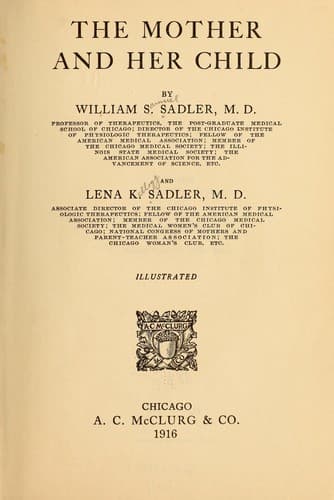
The Mother and Her ChildSadler, William S. (William Samuel)
Science
The Mother and Her Child
Sadler, William S. (William Samuel)
Child care; Infants -- Care; Infants -- Health and hygiene; Pregnancy
There used to be many dairymen like the old farmer who, when
interrogated by the health commissioner concerning the cleanliness of
his milk, laughed as he reached down into the bottom of a pail of
yellow milk and grabbing up a handful of manure and straw, said:
"That's what makes the youngsters grow." But it does not make them
grow; it often causes them to die, and even if they do live, they live
in spite of such contaminated food, for the germ which is always found
in the colon of the cow (_coli communis_), probably kills more babies
every year than any other single thing.
It is possible to reduce the growth of these germs by keeping the milk
at a very low temperature from the time it leaves the cow until the
moment it gets to the home refrigerator. Those which survive this
process of refrigeration may be quickly rendered harmless by
pasteurizing or sterilizing at the time of preparing baby's food.
In the absence of the modern sanitary dairy, we would suggest that the
milk supply be improved by giving attention to the following:
The cattle should be tested for tuberculosis every three months. The
walls of the cowhouse should be whitewashed three times a year. The
manure should be stored outside the barn. The floor of the cowhouse
should be sprinkled and swept each day. The cattle should be kept
clean--curried each day, and rubbed off with a damp cloth before
milking. The udders should be washed before each milking. The milker
can wear a clean white gown or linen duster which should be washed
every two days, while his hands should be washed just before the
milking. The milking pail should be of the covered sanitary order. The
barn should be screened.
CERTIFIED MILK
Immediately after leaving the cow, the milk should be cooled to at
least 45 F. It should at once be put into bottles that have been
previously sterilized and then be tightly covered, and should be kept
in ice water until ready for consumption. No matter how carefully the
milk is handled, it is infected with many bacteria, but if it is
quickly cooled, the increase of the bacteria is greatly retarded.
Under no circumstances buy milk from a grocery store out of a large
can. Go to your health officer and encourage him in his campaign for
sanitary dairies and certified milk.
Such milk as we have described under the head of sanitary dairies,
when it has been tested by the board of health and has received the
approval of the medical profession, is known as "certified milk;" and,
although the price is usually fifteen to twenty cents a quart, when
compared with the cost of baby's illness it will prove to be cheaper
than the dirty milk which sickens and kills the little folks.
There is no doubt that the increased use of "certified milk" has been
a great factor in the reduction of deaths from infant diarrhea in
recent years.
BOILING THE MILK
Public-domain text, read in full here on John Shaqi.
Reviews
Reviews
No reviews yet
Be the first to share your thoughts on this work.
Elsewhere in the archive
Join the Discussion
Join the discussion
Sign in to leave a comment or review.
Sign InorCreate an account