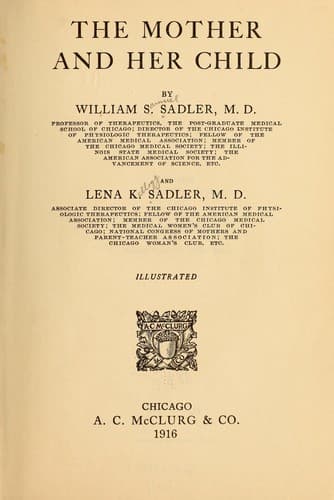
The Mother and Her ChildSadler, William S. (William Samuel)
Science
The Mother and Her Child
Sadler, William S. (William Samuel)
Child care; Infants -- Care; Infants -- Health and hygiene; Pregnancy
On the bottom of a large kettle filled with cold water, place an
ordinary flatiron stand upon which is put a folded towel. On this
place the bottle of milk as it comes from the dairyman, with the cap
of the bottle loosened. The cold water in the kettle should come up to
within an inch of the top of the bottle of milk. Heat this water
quickly up to just the boiling point--until you see the bubbles
beginning to rise to the top. The gas is then turned down or the
kettle is placed on the back of the range and held at this
near-boiling point for thirty minutes, after which it is taken to the
sink and cold water is turned into the water in the kettle, until the
bottle of milk is thoroughly cooled. It is now ready to be made up
into the modified food for baby.
Never let pasteurized milk stand in the room, nor put it near the ice
when warm. It must be cooled rapidly, as described above; that is,
within fifteen or twenty minutes.
The "spores" of the milk are not killed by pasteurization and they
hatch out rapidly unless the milk is kept very cold, and, as already
stated, it should be used within twenty-four hours after
pasteurization.
THE CARE OF BOTTLED MILK
The certified milk or the ordinary milk that has been delivered to
your home and is to be used without pasteurization or sterilization,
should receive the following care:
1. It should be placed at once in a portion of the ice box that is not
used to store such foods as radishes, cabbage, meats or any other open
dishes of food whose odors would quickly be absorbed by the milk. The
milk should never be left standing on the doorsteps in the sun, for
many reasons: the sun heats the milk, encourages the growth of
bacteria, and a passing cat or dog, whose mouth often contains the
germs of scarlet fever, tonsilitis, and diphtheria, should it be
hungry, laps the tops of the bottles, particularly in the winter when
the cream has frozen and is bulging over the edge.
2. It should never be kept in the warm kitchen, as when visiting her
sick baby we discovered one young mother doing. In answer to my
question, she explained; "Doctor, we do not take ice in the winter
time, everything is ice outdoors, so I just set the bottle outside the
window bringing it in whenever I need to give the baby some food. I
forget to put it out sometimes, but really now, does it matter?" It
really matters much, for you see, reader, the milk is first freezing
then thawing and it is rendered entirely unfit for the baby.
3. Milk should be kept covered and protected from dust and flies; it
should be kept in glass jars which have been sterilized by boiling
before being filled, and then placed in the refrigerator. If the milk
is sour, or if there is any sediment in the bottle, it is unfit for
baby's use.
CHAPTER XVIII
HOME MODIFICATION OF MILK
Public-domain text, read in full here on John Shaqi.
Reviews
Reviews
No reviews yet
Be the first to share your thoughts on this work.
Elsewhere in the archive
Join the Discussion
Join the discussion
Sign in to leave a comment or review.
Sign InorCreate an account