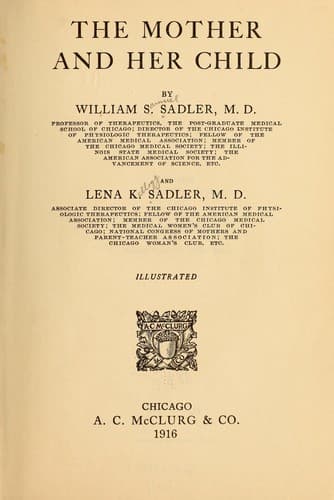
The Mother and Her ChildSadler, William S. (William Samuel)
Science
The Mother and Her Child
Sadler, William S. (William Samuel)
Child care; Infants -- Care; Infants -- Health and hygiene; Pregnancy
In many instances, and particularly if the infant is under six months
of age, and where he has had to have additional feeding from the
bottle--under such circumstances the breast milk may be continued as
"partial feeding," at least until the baby has reached his ninth or
tenth month, at which time it may be wholly discontinued.
At each nursing time the baby empties both breasts, and the amount he
draws may readily be estimated by carefully weighing him before and
after each nursing. By referring to the directions in a previous
chapter, the quantity of food needed for his size and age may be
determined; while the deficit is made up from a bottle of milk
containing properly modified cow's milk.
If the mother's health admits, or if the breasts continue to secrete a
partial meal for the babe, mixed feeding should be continued until
after the ninth or tenth month, when it can gradually be reduced from
four or five times each day to once or twice a day, until it is
finally omitted altogether. In the meantime, the baby is gradually
getting stronger food and at eleven or twelve months the little fellow
is able to subsist and thrive upon whole milk.
INFANT FEEDING PUZZLES
It is very difficult to explain how some babies thrive on some certain
food while others grow thin and speedily go into a decline on the same
regime. The hereditary tendencies and predispositions undoubtedly have
a great deal to do with such puzzling cases.
Again, sometimes a slight variation in technic or some other trifling
error in connection with the preparation of the baby's food, may be
more or less responsible for the variation in the results obtained. No
two mothers will prepare food exactly alike even when both are
following the same printed directions and these slight discrepancies
are enough to upset some delicately balanced baby.
On the other hand, some babies are born with such strong digestive
powers and such a powerful constitution that they are easily able to
survive almost any and all blunders as regards artificial feeding,
while at the same time they also manifest the ability to surmount a
score of other obstacles which the combined ignorance and carelessness
of their parents or caretakers unknowingly place in the pathway of
early life which these little folks must tread.
The fact that so many babies do so well on such unscientific feeding
only serves to demonstrate the old law of "the survival of the
fittest"--they are born in the world with an enormous endowment of
"survival qualities"--and in many cases the little fellows thrive and
grow no matter how atrociously they are fed.
There may be other factors in the explanation of why some babies do so
well on such poor care, but heredity is the chief explanation, while
adaptation is the other. If the little fellows can survive for a few
weeks or a few months, the human machine possesses marvelous powers of
adaptation, and we find here the explanation why many a neglected baby
pulls through.
INFANT FOODS
Public-domain text, read in full here on John Shaqi.
Reviews
Reviews
No reviews yet
Be the first to share your thoughts on this work.
Elsewhere in the archive
Join the Discussion
Join the discussion
Sign in to leave a comment or review.
Sign InorCreate an account