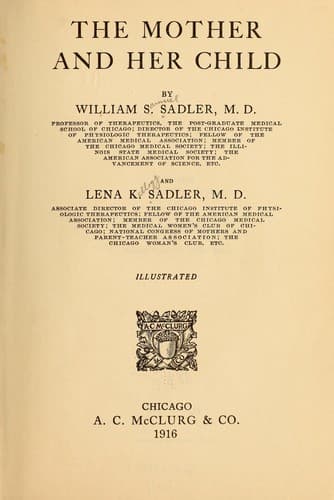
The Mother and Her ChildSadler, William S. (William Samuel)
Science
The Mother and Her Child
Sadler, William S. (William Samuel)
Child care; Infants -- Care; Infants -- Health and hygiene; Pregnancy
After the thorough drying of baby's upper body, a bit of talcum is put
under the arms, in the folds of neck, etc., and the shirt is slipped
on. Next the band, diaper, and stockings are removed and after first
oiling the groin and the folds of the thighs and the buttocks, the
same sponging, drying, and powdering is done here as on the upper
body.
The band is now applied, and _sewed on_. The diaper, stockings,
booties, and--if a winter baby--the skirt and outing flannel gown (for
babies should wear only night dresses for the first two or three
weeks) are now slipped over the feet and drawn upward, and baby is
ready for nursing or for his nap.
TEMPERATURE OF BATHS
First few weeks, 100 F.; early infancy, 98 F.; after six months, 97
F., cooling down to 90 F.
A wooden bath thermometer may be purchased for twenty-five cents and
it should be in every home where babies are bathed. In the absence of
a thermometer do not depend upon the hand to determine temperature.
Thrust the bared elbow into the water and if it is just
comfortable--neither hot or cool--it is probably about the correct
temperature for baby. Do not shock the baby by dashes of cold water,
for, while it may amuse an onlooker, it unnecessarily frightens your
child, and, subconsciously, he learns to dread his bath.
THE BATHING PLACE
If the bathroom is warm--temperature 75 F.--that is the most logical
place for the bath, provided baby has his own tub. Place a couple of
strong slats several inches wide across the big tub, six inches apart,
and on this place the baby's tub. Of course, care must be exercised
to prevent slipping by means of properly fitted cleats on the under
surface of the slats. The mother should always stand to bathe her baby
and the small tub should be placed at such a height that she neither
has to stoop nor bend. Thus the bathing of the baby becomes a pleasure
instead of a "job" or an "irksome task."
If the bathroom is not warm then the kitchen table or a small table
pulled up near the stove is a place par excellence for the dip.
Many boils seen on young baby's tender skin have been traced to the
careless use of the family tub to bathe the baby in. Not until the
child is two or three years of age, when his skin has become more
toughened, should he be allowed to use the family tub.
FREQUENCY OF BATHS
To begin with, we never bathe either a baby or an adult immediately
after a full meal. From one hour to one and one half hours should
intervene.
The frequency of baths depends somewhat upon the season of the year,
the vitality of the child, and the warmth of the home.
We have seen many infants who were bathed too often. The vitality
expended upon the necessary reaction following a tub bath was too much
for the little fellow; the daily bath was stopped and a semi-weekly
bath substituted, much to the gain of the child. Of course in this
instance the hands, face, and buttocks received a daily sponging.
Public-domain text, read in full here on John Shaqi.
Reviews
Reviews
No reviews yet
Be the first to share your thoughts on this work.
Elsewhere in the archive
Join the Discussion
Join the discussion
Sign in to leave a comment or review.
Sign InorCreate an account