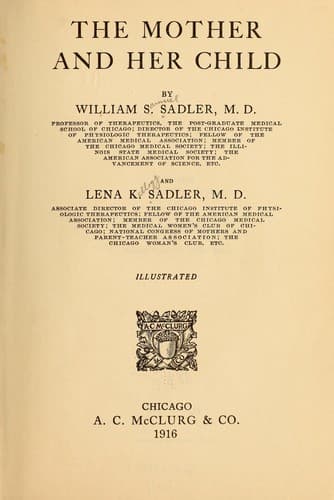
The Mother and Her ChildSadler, William S. (William Samuel)
Science
The Mother and Her Child
Sadler, William S. (William Samuel)
Child care; Infants -- Care; Infants -- Health and hygiene; Pregnancy
It does not seem possible in this enlightened age that a mother could
be so ignorant as to keep the socks up with brown soap, but the friend
assured me it was a true story, and while it may shock some of my
readers as it did me, I must add, in passing to another subject, that
the use of round garters on little babies and young children is just
about as shocking.
During the fall, winter, and spring, booties are worn on top of the
stockings. These booties should be crocheted or knitted out of the
heavy Germantown yarn, and there should be enough of them so that the
child may have a clean pair on every day.
SKIRTS AND PETTICOATS
The flannel petticoat is made with yokes instead of bands, and during
the fall, winter, and spring these yokes are made of flannel like the
skirt and should have long sleeves of the same material. The yokes
should be made large enough so that they may be used during the entire
first year (the plait in the front can easily be taken out when the
baby is six months old so that it may be used much longer than if the
yoke is made without a plait). For the hot summer months, the yokes
should be a thin cotton material without sleeves; and, if the baby is
housed in an over-heated apartment, this fact should be borne in mind
and the winter skirt should be made accordingly. We have found,
however, that the baby who is amply protected and uniformly dressed,
does not require the outer bundlings that the poorly dressed child
requires. Part wool and cotton materials are very comfortable in the
overheated city apartments. White skirts are not necessary for small
babies. They only add extra weight and it is always foolish to put
anything on a small baby simply for looks.
NIGHTGOWNS, WRAPPERS, AND SLIPS
The nightgowns should be made of soft cotton flannel or stockinet. The
latter is really the better, and can be purchased in sizes up to two
years; it is absorbent, easily laundered, and may be conveniently
drawn up at the bottom by means of a drawstring.
At least seven nightgowns are needed. A fresh nightgown should be used
each day and each night during the first four or five weeks of baby's
life; while as he gets older (two or three years), the night drawers
with feet in them are used to advantage.
The wrappers are usually made of challis, nun's veiling, cashmere, or
other light woolen materials which can be readily washed. They are
very serviceable to wear over the baby's thin slips and on cool nights
they may be used over the nightdress. They should be simply made,
containing no heavy seams, and at the neck there should be the
simplest kind of a soft band that will in no way produce friction or
in any other way irritate the baby's skin.
Public-domain text, read in full here on John Shaqi.
Reviews
Reviews
No reviews yet
Be the first to share your thoughts on this work.
Elsewhere in the archive
Join the Discussion
Join the discussion
Sign in to leave a comment or review.
Sign InorCreate an account