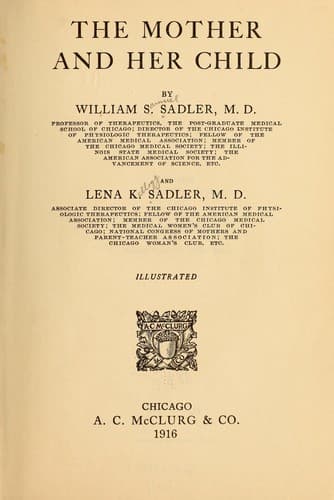
The Mother and Her ChildSadler, William S. (William Samuel)
Science
The Mother and Her Child
Sadler, William S. (William Samuel)
Child care; Infants -- Care; Infants -- Health and hygiene; Pregnancy
Always bear in mind the over-heating of the child with heavy garments
indoors, and the danger of skin chilling and drafts on going out to
play in this over-heated condition. Let the children dress comfortably
cool in the house, and as they go out to play add rubber boots or
leggings and rubbers, sweaters, caps with ear laps or the stockinet
cap. Allow them the utmost freedom in clothes, and always encourage
romping in the cool frosty air.
CLOTHING RULES
Do not overload the baby with clothing.
Dress according to the temperature of the day and not the season of
the year.
Avoid starched garments.
Avoid tight bellybands or old-fashioned pinning blankets.
Change all clothes night and morning.
Use woolen shirts and bands.
See that hands and feet are always warm.
Protect the abdomen night and day with the band.
Use the sleeping bag on cold nights.
Baby should sleep in loose stockings at night.
Avoid chilling the child.
Use hot water bags if necessary.
CHAPTER XXII
FRESH AIR, OUTINGS, AND SLEEP
Fresh air is just as important and necessary for the baby as for the
adult. Neither baby, youth, nor adult can receive the full benefit of
his food--in fact it can not be burned up without the oxygen--without
an abundance of fresh air. During the early weeks of life, the air
baby breathes must be warm; nevertheless, it must be warmed _fresh_
air, for baby requires fresh air just as much as he needs pure food.
INDOOR AIRING
The delicate child often requires more fresh air than does the normal
baby. Both appetite and sleep are improved by fresh air. The digestion
is better, the cheeks become pink, and all the signs of health are
seen in the child who is privileged to breathe fresh air.
During the early days, say after the third week, baby should be well
wrapped up with blanket and hood, tucked snugly in his basinet or
carriage, while the windows are opened wide and the little fellow is
permitted to enjoy a good airing. Even in the winter months the
windows may be raised in this way for a few minutes each day. These
"airings" may be for ten minutes at first, and, as the child grows
older, they may be gradually increased to four or five hours daily.
The carriage or basket should stand near the window, but not in a
direct draft.
OUTDOOR LIFE
In summer, a baby one week old may be taken out of doors for a few
minutes each day; in the spring and fall, when baby is one month old,
it may go out for an airing; while, during the winter months, the
airing had better be taken indoors until he is about two months old,
and even at that age he should go out only on pleasant days and should
always be well protected from the wind.
Public-domain text, read in full here on John Shaqi.
Reviews
Reviews
No reviews yet
Be the first to share your thoughts on this work.
Elsewhere in the archive
Join the Discussion
Join the discussion
Sign in to leave a comment or review.
Sign InorCreate an account