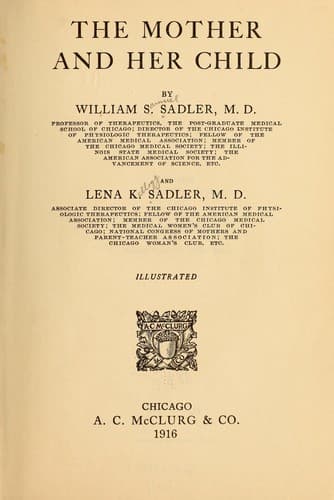
The Mother and Her ChildSadler, William S. (William Samuel)
Science
The Mother and Her Child
Sadler, William S. (William Samuel)
Child care; Infants -- Care; Infants -- Health and hygiene; Pregnancy
Children differ greatly in the growth of hair. Some of them come into
the world with heavy hair, and others lose it quickly and remain
nearly bald-headed until after the first year.
As the second hair grows in, it is usually lighter than it was at
birth and lighter than it will be later in life, as the hair has a
tendency to grow darker as the years go by.
The scalp should receive the care already mentioned. As the hair comes
in it should be shampooed once in two weeks and brushed often, making
it healthy and vigorous.
MISSHAPEN HEADS
It is wise to turn the baby first on one side and then on the other
and not allow him to sleep night after night on one side of his head.
The newborn head may be misshapen by laying the child constantly on
one side, and the ear may be misshapen if it is allowed to curl under
or become pressed forward. Markedly protruding ears may be partially
corrected by having the child wear a well-ventilated cap made for the
purpose.
THE SALIVA
Many mothers think that the presence of drooling or the excessive flow
of saliva is associated with teeth cutting. While it may be associated
with the teeth, this is not usually the case; it is more probably due
to the beginning of a new function of secretion. The newborn baby has
only enough saliva to furnish moisture for the mouth, and not until
the age of four or five months does saliva really flow, and since the
teeth appear a bit later we often confuse the institution of a new
secretion with the oncoming teeth.
SENSATIONS AND RECOGNITION
The young baby manifests a number of sensations early in its career.
Hunger and satisfaction as well as comfort and discomfort seem to be
recognized by the little fellow. He early learns that the approach of
someone when he cries usually means that he is to be taken up, and he
usually ceases crying as soon as he is taken up. He early manifests a
sense of comfort when he is cuddled; there also is early present a
manifestation of the desire to sleep, and the satisfying pleasure of a
drink of water.
At the age of three months he has recognized many things such as the
light or a bright object. He distinctly recognizes his mother and
often smiles at her approach. He recognizes his hands at four months,
and now begins to recognize other members of the household aside from
his mother. Even as early as one month, he may smile at his mother. At
two months of age he will often smile at other members of the family.
He laughs out loud or chuckles during the fourth or fifth month. But,
on the whole, he must be considered as just a little animal whose
greatest needs are to have his appetite and thirst satisfied, his
little body clothed, and his little nerves put to rest--to sleep.
SITTING ALONE
Public-domain text, read in full here on John Shaqi.
Reviews
Reviews
No reviews yet
Be the first to share your thoughts on this work.
Elsewhere in the archive
Join the Discussion
Join the discussion
Sign in to leave a comment or review.
Sign InorCreate an account