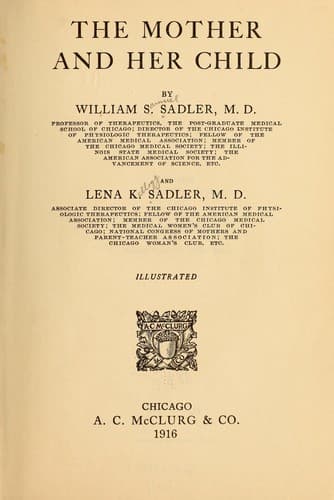
The Mother and Her ChildSadler, William S. (William Samuel)
Science
The Mother and Her Child
Sadler, William S. (William Samuel)
Child care; Infants -- Care; Infants -- Health and hygiene; Pregnancy
Urine that is high-colored and stains the diaper, or that shows a
thick, reddish cloud after standing, may accompany fever or
indigestion. Sometimes the urine under these conditions is milky
when first passed. In some babies a diet containing beef juice or
other highly nitrogenous food will produce the reddish cloud, or
even actual, red, sandlike particles. A decidedly yellow stain on
the diaper occurs when there is jaundice. A faint reddish stain
seldom indicates blood. The amount of urine passed is scanty in
fever, in diarrhea, and especially in acute Bright's disease. In
the latter disease the urine is often of a smoky or even a muddy
appearance. The possibility of the occurrence of this symptom
after scarlet fever must always be kept in mind, in order that a
physician may be summoned very quickly, since it is a serious
matter.
THE STOOLS
We find that the passages are often putty-colored in disorders of
the liver, frequently bloody or tarry in appearance in bleeding
within the bowel, and liable to be black after taking bismuth,
charcoal, or iron, and red after krameria, kino, or haematoxylon.
Infants who are receiving more milk than they can digest
constantly have whitish lumps in their stools, or even entirely
formed but almost white passages. The presence of a certain
amount of greenish coloration of the passages is not infrequent.
This is usually an evidence of indigestion, but passages which
are yellow when passed and turn to a faint pea green some time
later are not an indication of disease.
WHEN BABY GETS SICK
When baby shows that he is sick, take his temperature as directed
elsewhere, cut down the feeding to at least one half, or, if his
temperature is around 102 F. give him nothing but rice water or barley
water. If he is constipated give him a cleansing enema, and if hot and
feverish a sponge bath may be administered. He should then be put into
a bed with light covers and wait further orders which the doctor will
give on his arrival. Give the baby no medicine unless ordered to do so
by the physician.
Known to every physician who undertakes the care of children, is the
failure of many well-meaning mothers to call him early. The mother
attempts the care of the baby herself, and not until the condition
gets beyond her knowledge and wisdom does she seek medical advice. In
the early hours of an approaching cold, the beginning of intestinal
indigestion, or at the beginning of bronchitis, if the physician can
see the child early, prolonged illness may be avoided as well as
unnecessary expense and many heart-breaking experiences.
FEEDING THE SICK BABY
Public-domain text, read in full here on John Shaqi.
Reviews
Reviews
No reviews yet
Be the first to share your thoughts on this work.
Elsewhere in the archive
Join the Discussion
Join the discussion
Sign in to leave a comment or review.
Sign InorCreate an account