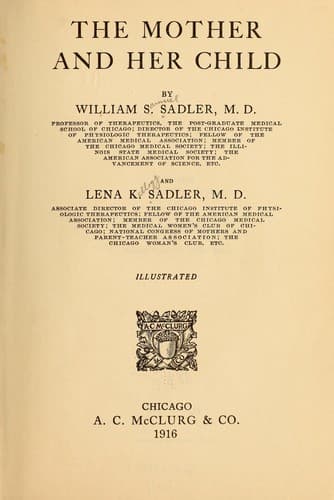
The Mother and Her ChildSadler, William S. (William Samuel)
Science
The Mother and Her Child
Sadler, William S. (William Samuel)
Child care; Infants -- Care; Infants -- Health and hygiene; Pregnancy
It is far better when the throat is to be examined to wrap the child
in a shawl or a sheet with his arms placed at his side, and for a
member of the family to take him in her lap and hold him securely
while the physician quickly makes the observation. And while we
appreciate that sickness is not the time to introduce new methods of
training, in instances where children have been spoiled, it is far
better quietly and firmly to go about the task in a manner that you
know can be carried through to a successful finish.
TREATMENT OF SICK CHILDREN
A sick child should be encouraged to lie in his bed much of the time,
and the bed should be kept clean and cool. He should never be set up
suddenly or laid back quickly. In the case of a broken leg, all rapid
movements should be avoided. A simple story or a soothing lullaby, or
the giving of a toy, will often divert attention when some painful
movement must be made or some disagreeable task performed.
Both cleanliness of the body and cleanliness of the mouth are
exceedingly necessary in sickness. In all instances of disease or
indisposition, the mouth must receive daily care, for stomatitis or
gangrene of the mouth often follows neglect. A listerine wash in
proportion of one to four, or a magnesia wash, or the addition of a
few drops of essence of cinnamon to the mouth wash will do much to
prevent such conditions, as well as to relieve them.
Applications of medicine to the throat may be made without resistance
if the tactful nurse watches her time. She should slowly introduce the
tongue depressor which may be a flat stick or a spoon, when the
application of medicine with a camel's-hair brush is quickly made to
the rolled-out throat as the child gags, and if the nurse then quickly
diverts his attention to some beautiful story or a picture or a new
toy, the treatment is soon forgotten. Under no circumstances argue
with or scold a sick child. Get everything ready, if possible behind
his back or in another room, and then with plenty of help make the
application or the observation without words, always with gentleness
and firmness.
NURSING RECORDS
Whether the nurse be the mother, caretaker, practical or professional
nurse, a record should always be kept of the condition of the patient.
The temperature should be reported at different periods designated by
the physician. The pulse should be recorded, the amount of urine
passed and the time it was passed, the number of bowel movements, all
feedings and the general well being of the child--whether it is
restless or comfortable, sleeping or awake, together with the water
that he drinks.
The record may be kept, if necessary, on a piece of common letter
paper, and should read something like this:
March 26, 1916
7 A. M. Temperature 102; pulse 132; respiration 40; morning
toilet; took 4 ounces of milk; 2 ounces of barley water; 1 ounce
of lime water.
Public-domain text, read in full here on John Shaqi.
Reviews
Reviews
No reviews yet
Be the first to share your thoughts on this work.
Elsewhere in the archive
Join the Discussion
Join the discussion
Sign in to leave a comment or review.
Sign InorCreate an account