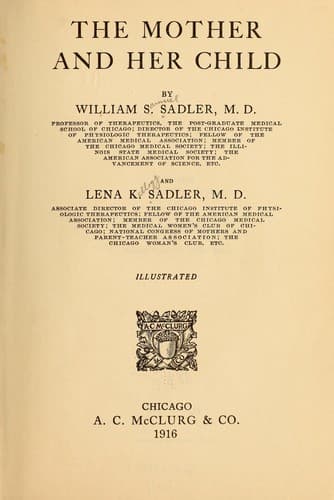
The Mother and Her ChildSadler, William S. (William Samuel)
Science
The Mother and Her Child
Sadler, William S. (William Samuel)
Child care; Infants -- Care; Infants -- Health and hygiene; Pregnancy
The respirations of a child are fairly regular and rhythmic and occur
about forty times per minute during the first month of life and about
thirty times per minute during the remainder of the year. From one to
two years, twenty-six to twenty-eight is the average. Breathing is
somewhat irregular when the child is awake and may be a bit slower
when asleep. Before the baby is born the fetal pulse is about 150. At
birth it ranges from 130 to 140. During the first month the pulse is
found to be from 120 to 140. By the sixth month it gets down to 120 or
130, and from that on to a year the normal pulse beat of the baby is
about 120. The pulse is influenced very much by exercise and is often
increased by crying or nursing or any other excitement.
FEVER
Children get fever very easily--the digestive disturbance of
overeating, constipation, a slight bilious attack--all produce fever
which disappears quite as suddenly as it came. The first thing to do
under such circumstances is to withhold food, give plenty of water to
drink, produce a brisk movement of the bowel by giving a dose of
castor oil, give a cleansing enema, and treat the fever as follows:
After removing all of the clothes from the child, place him in a warm
blanket and then prepare a sponge bath which may be equal parts of
alcohol and water; expose one portion of the body at a time and apply
the water and alcohol first to one arm and then to the other arm, the
chest, one leg, the other leg, the back and then the buttocks. Do not
dry the part but allow evaporation to take place, and this,
accompanied by the cooling of the blood which is brought to the skin
by the friction, readily reduces the fever. Another procedure which
may be employed if the fever registers high is the wet-sheet pack
which is administered as follows:
Three thicknesses of wool blankets are placed on the bed and a sheet
as long as the baby and just enough to wrap around him once, is wrung
out of cool water and spread over these blankets. With a hot-water
bottle to the feet, the child is then laid down in the wet sheet which
is now brought in contact with every portion of his body, then the
blankets are quickly brought around, and he is allowed to warm up the
sheet--which lowers his temperature.
Another valuable procedure is the cooling enema. Water the same
temperature as that of the body, is allowed to enter the bowel and is
then quickly cooled down to 90 or 85 F.; in this manner much heat is
taken out of the body and the fever quickly reduced. (For further
treatment of fevers see Appendix.)
CHAPTER XXVI
BABY'S SICK ROOM
Public-domain text, read in full here on John Shaqi.
Reviews
Reviews
No reviews yet
Be the first to share your thoughts on this work.
Elsewhere in the archive
Join the Discussion
Join the discussion
Sign in to leave a comment or review.
Sign InorCreate an account