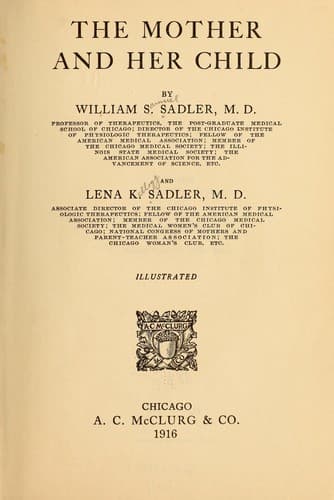
The Mother and Her ChildSadler, William S. (William Samuel)
Science
The Mother and Her Child
Sadler, William S. (William Samuel)
Child care; Infants -- Care; Infants -- Health and hygiene; Pregnancy
The sick room medicine chest should be so placed on the wall that it
is outside the reach of the smaller members of the family, for in it
should be placed poisons for external use that are capable of
producing death if taken internally. Bottles that hold these
poisons--such as bichlorid of mercury, lysol, carbolic acid, laudanum,
paregoric, belladonna, etc.--should be so different from the other
bottles in the medicine chest that if one should reach for them with
his eyes shut or in the dark he would at once recognize that he had
hold of a poison bottle. This is absolutely necessary. It usually
means a bit of extra expense, but when we realize what tragedies may
be avoided by such slight expense, it must not be considered.
Bottles may be procured that have been molded with points of glass
projecting from the outside which make them rough to the touch, or
they may be covered with a wire mesh or with a wicker covering which
may easily be told from the other bottles in the case.
One woman lost her life because the nurse placed two ounces of
carbolic acid in the enema instead of two ounces of saline solution.
Saline solution is nothing but salt and water, while carbolic acid
cost the woman her life, simply because the carbolic acid was not
placed in a specialized poison bottle and the attendant could not read
the label in the dark.
Under no circumstances keep from one year to another the remnants of
unused medicine of a former sickness, for medicines do not keep well
and often lose their strength if kept longer than the physician
intended.
In this medicine chest should be found the following articles:
A glass graduate marked with fluid drachms (1 teaspoon),
and fluid ounces (8 teaspoons).
A medicine dropper.
Absorbent cotton.
Boric acid.
Camphorated oil.
Castor oil.
Aromatic spirits of ammonia.
Alcohol.
Olive oil.
Epsom salts.
Soda-mint tablets.
Vaseline.
Zinc ointment, together with other medicines the physician
orders.
Ice bag, hot-water bottle and oiled silk.
Besides these articles, in the nursery--in readiness for emergencies
and accidents--should be found the following:
Gauze bandages of various sizes.
Sterile gauze.
Boric acid crystals and powder.
Mustard.
A pocket case of instruments containing scissors, knife, dressing
forceps, etc.
Syrup of ipecac.
Glycerin.
Tincture of iodine.
Package of ordinary baking soda.
Peroxid of hydrogen.
Absorbent cotton.
Needle and thread.
Lime water.
PATENT MEDICINES
Public-domain text, read in full here on John Shaqi.
Reviews
Reviews
No reviews yet
Be the first to share your thoughts on this work.
Elsewhere in the archive
Join the Discussion
Join the discussion
Sign in to leave a comment or review.
Sign InorCreate an account