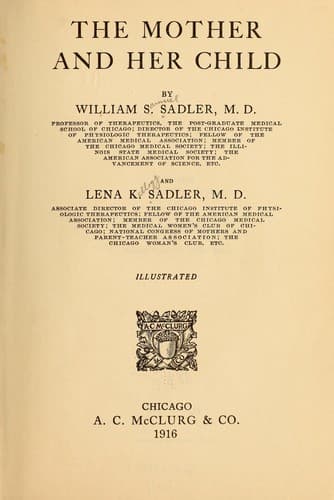
The Mother and Her ChildSadler, William S. (William Samuel)
Science
The Mother and Her Child
Sadler, William S. (William Samuel)
Child care; Infants -- Care; Infants -- Health and hygiene; Pregnancy
Measles, one of the most common diseases of childhood, is not to be
regarded lightly, for very often its sequelae--running ears, weak
eyes, and bronchial coughs--may prove very serious and troublesome.
Tuberculosis of the lungs not infrequently follows in the wake of
measles. The early symptoms of measles are so mild that often the
child is out of doors, at school, or about his usual play, until the
second or third day of the fever. He was supposed merely to be
suffering from a simple "cold in the head."
On the third or fourth day the patient begins heavy sneezing and wears
a stupid expression; and it is then that the mother ascertains that
his temperature is perhaps 101 to 102 F. He is put to bed and the next
day the rash usually appears. The rash is peculiar to itself, not
usually mistaken for anything else, being a purplish red, slightly
elevated, flattened papule, about the size of a split pea. The
coughing, which is very annoying, usually remains until about the
seventh or eighth day--at which time the fever also disappears.
The bowels must be kept open; a daily bath be given--in which has been
dissolved a small amount of bicarbonate of soda (simple baking
soda)--after which an oil rub should be administered. The nose should
be frequently sprayed with three per cent camphor-menthol-alboline
spray, while the throat is gargled with equal parts of alcohol and
water. The feet should be kept warm by external heat, while the
physician in charge may order additional attention to the chest, such
as a pneumonia jacket, etc.
Care should be taken to guard against "catching cold," for bronchitis
or pneumonia is quite likely to develop in many cases of measles. The
eyes should be protected by goggles and the room should be darkened;
under no circumstances should the little patient be allowed to read.
Carelessness in this respect may mean weakened eyesight all the rest
of his life. Until two weeks after the rash has disappeared, the
little fellow should be kept by himself, for the desquamation keeps up
almost continuously during this time.
The food during the course of the disease is a liquid and soft diet.
Children should never be allowed to go to a party or gathering with a
cold in the head; the mothers of a group of small children will never
forget the time that one certain mother allowed her little fellow to
attend a party with "simply a cold in the head." He laughed, talked,
and sneezed during the afternoon and when he went home the rash
appeared that night, while eight of the ten exposed children came down
with measles during the next two weeks.
CHICKENPOX
Public-domain text, read in full here on John Shaqi.
Reviews
Reviews
No reviews yet
Be the first to share your thoughts on this work.
Elsewhere in the archive
Join the Discussion
Join the discussion
Sign in to leave a comment or review.
Sign InorCreate an account