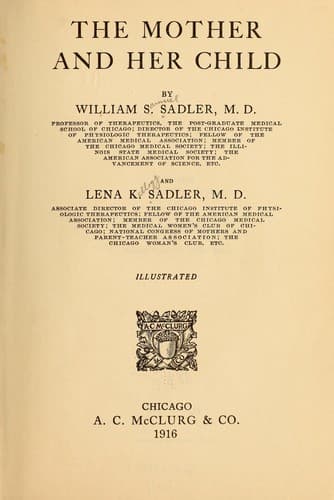
The Mother and Her ChildSadler, William S. (William Samuel)
Science
The Mother and Her Child
Sadler, William S. (William Samuel)
Child care; Infants -- Care; Infants -- Health and hygiene; Pregnancy
If proper surgical cleanliness is practiced and ample protection is
afforded in after dressing, vaccination need not be a taxing process.
The child suffers from general lassitude--a little drowsiness with
loss of appetite and a small amount of fever--but this passes off in a
reasonable length of time, especially if he is not overfed and his
bowels are looked after. On the second or third day after vaccination
a red papule appears which soon grows larger, and, after five or six
days, it becomes filled with a watery fluid. By the tenth day it has
the appearance of a pustule about the size of a ten-cent piece,
surrounded by a red areola about three inches in diameter. At the end
of two weeks the pustule has dried down to a good crust or scab, in
another week it falls off, leaving a pitted white scar.
If the vaccination does not take, it should be repeated after an
interval of two months.
DIPHTHERIA
Diphtheria is a disease much dreaded during childhood and adolescence.
It may attack any age--even little babies are susceptible. It begins
with a general feeling of heavy, drowsy lassitude with a sore throat.
White spots appear on the tonsils which may resemble a simple
follicular tonsillitis, while in a short time white patches spread
over the throat and tonsils.
It is not at all uncommon for this membrane to attack the nose,
producing a bloody, pustular discharge; and when it does attack the
nose, it is none the less contagious and must be regarded just as
seriously. A physician is called at once, and, not only to the child,
but to the other members of the family, antitoxin is immediately
administered. The disease runs a regular course and its most dangerous
complication is the membrane which forms in the larynx and threatens
to suffocate the child unless prompt intubation is performed--the
slipping of a silver tube in the larynx to prevent suffocation and
death. The early use of antitoxin greatly lessens all these serious
complications.
Care must be exercised to prevent sudden heart failure; and this is
done by raising the child to an upright position with the utmost care;
while you insist upon him lying quietly upon his back or his side,
long after the disease has left his throat. While the throat or nose
is the seat of disease, the toxins from these most dreaded
diphtheritic microbes spread through the lymph channels and the blood
vessels to the heart itself--so weakening that organ that it sometimes
suddenly fails, or becomes more or less crippled for life. These
serious results are to be prevented by the science of good nursing and
the prompt use of antitoxin. In these days the "Schick test" may be
administered for the purpose of ascertaining whether one is
susceptible to contracting diphtheria.
Public-domain text, read in full here on John Shaqi.
Reviews
Reviews
No reviews yet
Be the first to share your thoughts on this work.
Elsewhere in the archive
Join the Discussion
Join the discussion
Sign in to leave a comment or review.
Sign InorCreate an account