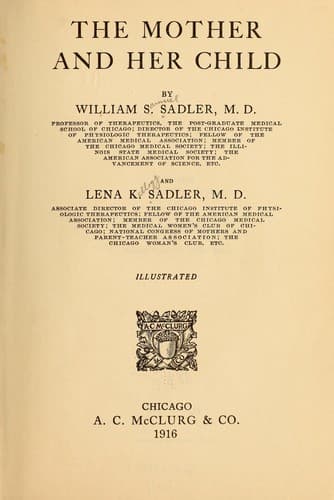
The Mother and Her ChildSadler, William S. (William Samuel)
Science
The Mother and Her Child
Sadler, William S. (William Samuel)
Child care; Infants -- Care; Infants -- Health and hygiene; Pregnancy
We so often hear "mother love" eulogized. It is a wonderful and
self-denying human trait; but, as a physician, I have been led to
believe that "mother loyalty" is of almost equal or even greater
value. All mothers love their children more or less, but only a few
mothers possess that superb loyalty which is able to rise above human
sympathy and maternal love, which qualifies the mother to stand
smilingly by the side of the crib and watch her little one in a fit of
anger--yelling at the top of its voice--and yet never touch the child,
allow the little fellow to come to himself, to wake up to the fact
that all his yelling, his emotion, his anger, and his resentment are
absolutely powerless to move his mother. Thus has the mother--by her
loyalty to the little fellow--taught him a new lesson in self-control,
and thus has she added one more strong link in the chain of character
which parent and child are forging day by day, and which finally must
determine both the child's temporal and eternal destiny.
SYSTEM AND ORDER
System and order are desirable acquisitions for all children, but they
are absolutely indispensable to the successful rearing of the nervous
child, who should be taught to have a place for everything and
everything in its place. When he enters the house his clothes must not
be thoughtlessly thrown about. Every garment must be put in its proper
place. These little folks must be taught a systematic and regular way
of doing things.
Nervous children must not be allowed to procrastinate. They must not
be allowed to put off until tomorrow anything which can be done today.
They must be taught how to keep the working decks of life
clear--caught right up to the minute. They should be taught proper
methods of analysis--how to go to the bottom of things--how to render
a decision, execute it, and then move forward quickly to the next
task of life. When they come home from school with home work to do it
would be best, as a rule, first to do the school work before engaging
in play. In fact, all the methods which are needful for the proper
discipline of the ordinary child are more than doubly needful for the
training of the nervous child; while more than fourfold persistence is
needed on the part of parents to make them really effective.
EMOTIONAL RUNAWAYS
Whether the child be two years of age or ten years of age, when the
parent discovers that the nervous system is "losing its head," that
the child is embarking on a nervous runaway, or that it is about to
indulge in an emotional sprawl, it is best to interfere suddenly and
spectacularly. Lay a firm hand on him and bring things to a sudden
stop. Speak to him calmly and deliberately, but firmly. Set him on a
chair, put him in the bed, or take him to a room and isolate him.
Public-domain text, read in full here on John Shaqi.
Reviews
Reviews
No reviews yet
Be the first to share your thoughts on this work.
Elsewhere in the archive
Join the Discussion
Join the discussion
Sign in to leave a comment or review.
Sign InorCreate an account