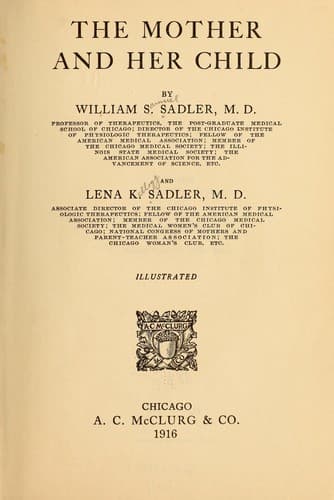
The Mother and Her ChildSadler, William S. (William Samuel)
Science
The Mother and Her Child
Sadler, William S. (William Samuel)
Child care; Infants -- Care; Infants -- Health and hygiene; Pregnancy
_Deaf-Mutism._ The child born deaf pays no attention whatever to
sounds. An intellectual expression is seen on his face and by six
months he is able to do all that a normal baby can do with the
exception of hearing. The child should early be taken to an ear
specialist in the endeavor, if possible, to correct the defect of
hearing. Such little ones who are destined to a life without sound,
should be given every opportunity to learn to read the lips and to
secure a good education--to be taught a vocation where eyesight is of
more value than hearing. Special institutions are in existence today
which can take these deaf mutes when small and so teach them to make
audible sounds that they can make themselves understood--at least
partially. Lip reading is a wonderful improvement over the deaf and
dumb alphabet, and should be taught early.
_Congenital Blindness._ Perhaps not until the child is six months old
can the observer distinguish between blindness and idiocy. The blind
child of course will not fix his eyes upon any object; but the general
lassitude and the inability to hold up its head, while seen in idiocy,
is not present in blindness.
_Feeble Mindedness._ A baby that is born with a weak mind is found to
be very backward in all the normal developmental attainments of the
growing child. A normal baby holds up its head at four months and
should be able to sit erect at six months. The weak-minded baby will
not do this, and often as late as two years it will not make any
attempt to walk or to talk. There is an unnatural expression--a vacant
look--to the face, while there is often much dribbling at the mouth.
_Early Training should be Instituted._ It is necessary to call the
attention of a physician to these facts, that the parents may be
instructed in regard to the early training which is so essential in
all these weak-minded little folk. In our opinion it is best to remove
these children early to special institutions, where their education
can be superintended by those thoroughly accomplished and accustomed
to dealing with this class. There are varying grades of feeble
mindedness--the backward child who requires a longer time to learn
things, and the child who is slow at school and possibly cannot get
through more than the fourth or fifth grade--but as soon as weak
mindedness is discovered, it is best to transfer the child to some
special institution.
CHAPTER XXXII
SKIN TROUBLES
Public-domain text, read in full here on John Shaqi.
Reviews
Reviews
No reviews yet
Be the first to share your thoughts on this work.
Elsewhere in the archive
Join the Discussion
Join the discussion
Sign in to leave a comment or review.
Sign InorCreate an account