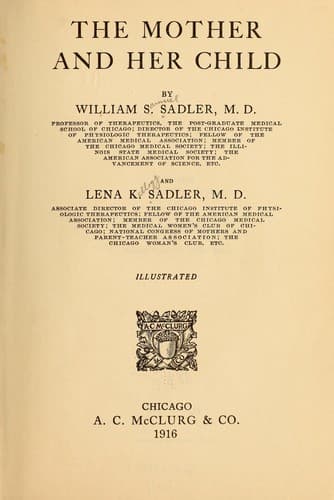
The Mother and Her ChildSadler, William S. (William Samuel)
Science
The Mother and Her Child
Sadler, William S. (William Samuel)
Child care; Infants -- Care; Infants -- Health and hygiene; Pregnancy
Vulvovaginitis is a very contagious disease, and before the days of
hospital asepsis, which is so perfectly maintained today in our large
institutions, this disease used to go right through a children's ward
because of carelessness in the handling of soiled diapers, etc. The
sign of this disease is a yellow-white vaginal discharge, while the
surrounding skin covering the inside of the thighs and buttocks may be
very much reddened. The baby should be taken at once to the physician
at the first appearance of these symptoms. Only rigid isolation can
possibly prevent other children from getting it--essentials are
separate towels, wash towels, soap (in the case of the older
children), and, in the case of the baby, separate diapers and rigid
scrubbing of the attendant's hands--in this way only can this
infection be held in check. The infected child should sleep by
herself, and utmost care must be exercised in preventing her fingers
from first touching the itching vulva and then placing them to the
eyes or to the mother's eyes. A vulva pad must be worn as long as the
disease lasts. The physician will give you the proper medicines to be
used in these cases, and if no physician is within reach, you are
perfectly safe in dropping into the spread apart vulva a few drops of
twenty-per-cent argyrol and then applying the vulva pad. After each
treatment the hands of the mother or nurse must be most rigidly
cleansed.
ECZEMA
Eczema is a very troublesome disease, particularly in infants; there
are so many forms of it that there is neither time nor space in this
volume to describe them individually. This disease may be produced in
children by either internal or external causes--from friction on the
skin, from coarse, rough woolen clothes, or from starched garments, or
from lace or starched bonnet strings which rub into the folds of the
skin. Irritating soap, the contact of soiled diapers, cheap toilet
powders, and discharges from the nose and ears may also be responsible
for the disease. The particular internal causes are over-feeding,
digestive disturbances, the too early use of starches which create
fermentation in the intestinal tract. In the most frequent form of
eczema the skin becomes red and then there appear tiny vesicles (water
blisters) which soon rupture and "weep." This fluid which oozes from
these tiny, ruptured vesicles, in connection with the perspiration and
exfoliation of old skin, forms heavy crusts upon the face which are
both unsightly and annoying.
Public-domain text, read in full here on John Shaqi.
Reviews
Reviews
No reviews yet
Be the first to share your thoughts on this work.
Elsewhere in the archive
Join the Discussion
Join the discussion
Sign in to leave a comment or review.
Sign InorCreate an account