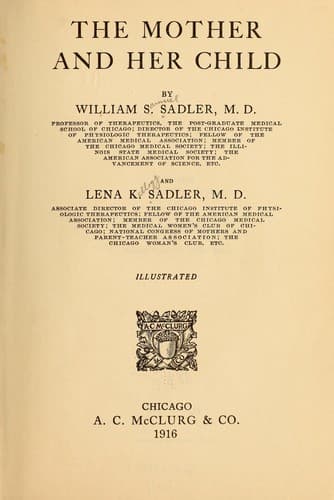
The Mother and Her ChildSadler, William S. (William Samuel)
Science
The Mother and Her Child
Sadler, William S. (William Samuel)
Child care; Infants -- Care; Infants -- Health and hygiene; Pregnancy
Diseased tonsils not only are often--very often--the avenue of entry
of infectious microorganisms that cause one type of rheumatism, but
many forms of valvular heart disease are also directly traceable to
these same diseased tonsils. The treatment consists in giving proper
attention to the tonsils, even removal if necessary--and if the child
is old enough. All other possible causes should be located and
removed; the child should have absolute rest in bed with brisk
cathartics and a liquid diet (no meat broths). The diet should consist
more of alkalinizing foods as shown in the special table in the
appendix. Medicinal alkalines are often given when the urine shows a
very high acid reaction.
SCURVY
Scurvy, seen in children who subsist on "prepared foods," is
manifested by tender legs and swollen gums which have a tendency to
bleed easily. Pallor, loss of appetite, and insomnia accompany the
condition. The treatment of scurvy is change of diet from "patent
foods" to fresh cow's milk, with the addition of orange juice, daily.
In older children the food must be very nutritious; out of door life,
salt glows, friction baths (see appendix), and the taking of large
amounts of fats are all essential to the cure.
ADENITIS--ENLARGED GLANDS
Enlarged glands, or what our grandmothers used to call "kernels" in
the throat are often the result of inflammation in the mouth or
throat, and occur in connection with many of the childhood diseases,
notably diphtheria, scarlet fever, and scarlatina.
Glands appearing in the back of the neck may be occasioned by
pediculli (lice), ring worm, or eczema, while those seen in the neck
just back and below the ears may come from mastoiditis (inflammation
of the middle ear) or adenoids.
Glands felt under the arm enlarge because of trouble or infection in
the breast, hand, or arm; while glands in the groin are usually due to
some infection of the feet, legs, or abdomen.
These glands usually disappear when the general health and well-being
of the child is improved by:
1. Outdoor life.
2. Morning dry-friction rub to the skin.
3. Good liberal diet, including plenty of fats.
4. No feeding between meals.
5. The salt glow and general tonic treatment (see appendix).
6. The oil rub at night.
RICKETS
Rickets (a disease of the bones) often follows in the wake of faulty
feeding and unhygienic surroundings. The bones lack a proper amount of
lime salts and other elements. Development in general, especially that
of the bones, is greatly interfered with.
Bowlegs, prominent square brow, enlarged perspiring head, weakness,
and often tenderness of the flesh, are notable signs of the disease.
The treatment varies little from that of scurvy, and will be provided
in detail by the attending physician.
MALARIA
Public-domain text, read in full here on John Shaqi.
Reviews
Reviews
No reviews yet
Be the first to share your thoughts on this work.
Elsewhere in the archive
Join the Discussion
Join the discussion
Sign in to leave a comment or review.
Sign InorCreate an account