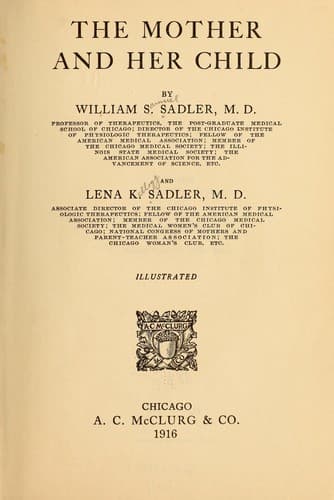
The Mother and Her ChildSadler, William S. (William Samuel)
Science
The Mother and Her Child
Sadler, William S. (William Samuel)
Child care; Infants -- Care; Infants -- Health and hygiene; Pregnancy
Fishhooks are exceedingly troublesome, as they often occasion the
enlarging of the wound to get them out, especially if they have gone
in beyond the barb.
Slivers are easily broken off, so great care is needed in their
removal. A pair of tweezers is convenient for seizing the protruding
portion, while all side movements are avoided lest it break off in the
flesh, in which case it may be gotten out with a needle that has been
sterilized in a flame.
All puncture wounds should be dressed with the wet, sterile compress,
covered over with wax paper and bandaged loosely; this encourages
cleanliness and favors healing.
BRUISES
If left untreated, bruises swell, become highly discolored, and in the
process of healing pass through the dark blue, green, and yellow
stages. The treatment is as follows: Apply hot and cold
alternately--the heat should be as hot as can be borne and left on
very hot for three minutes, then ice water compresses should be
applied for one minute, then hot again--these changes should continue
for an hour, and if carried out immediately after the injury all
discolorations and most of the swelling may be avoided. Witch-hazel
compresses are comforting. If discoloration has taken place, the
application of hot compresses will often hasten its disappearance.
FRACTURES AND DISLOCATIONS
While there is very little a member of the family or a non-medical
friend can do in case of a fracture, and while it is unwise to offer
suggestions relative to the setting of bones, yet it is highly
important that both the family and friends know how properly to
support a broken leg while carrying a disabled person into the house
or to near-by medical aid.
For instance, in the case of a fractured leg below the knee, if a
couple of flat boards three inches wide be tied about the leg with two
pocket handkerchiefs, the ends of the fractured bone will not rub
against each other and the pain will be much less in carrying. In
this way all danger of causing the broken bones to protrude and thus
"compounding" the fracture is also avoided. And also, if there is no
near-by ambulance, a good emergency stretcher may be improvised out of
two or three buttoned vests with two poles, rakes, or brooms run
through the armholes--one vest under the shoulders and one under the
hips and still another under the fracture. An injured person may in
this way be carried for miles quite comfortably.
Two people may fashion a seat out of their four hands on which the
disabled child may sit with his arms about the necks of his two
friends. If the fractured end of the bone penetrates the flesh it is
then known as a compound fracture and the utmost cleanliness must
prevail--as in dressing other wounds. An X ray laboratory should
always be sought, where convenient, to ascertain if the ends of the
bones are in good position.
Public-domain text, read in full here on John Shaqi.
Reviews
Reviews
No reviews yet
Be the first to share your thoughts on this work.
Elsewhere in the archive
Join the Discussion
Join the discussion
Sign in to leave a comment or review.
Sign InorCreate an account